
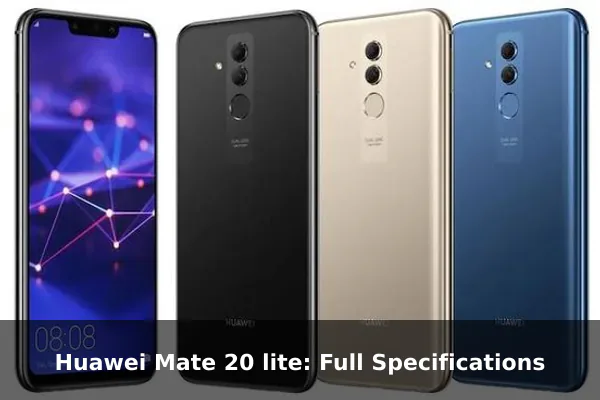
The Huawei Mate 20 lite arrived in September 2018 as the accessible gateway into Huawei’s flagship Mate 20 family, pairing a tall 6.3-inch IPS LCD with the then-new Kirin 710 chipset. Positioned around 230 EUR at launch, it set out to deliver a premium glass-and-metal feel, dual cameras on both sides, and respectable mid-range performance without crossing into flagship pricing territory.
Years after release, this phone is interesting as a snapshot of where Huawei’s mid-range strategy stood before US trade restrictions reshaped its software roadmap. This article explores the Mate 20 lite from a buyer-perspective angle: how its hardware has aged, what its EMUI 12 upgrade actually unlocked, and which kinds of users may still find value in tracking down a unit today.
Full Specifications
Network
| Technology | GSM / HSPA / LTE |
| 2G bands | GSM 850 / 900 / 1800 / 1900 |
| 3G bands | HSDPA 850 / 900 / 1700(AWS) / 1900 / 2100 – SNE-LX1, SNE-LX3 |
| HSDPA 850 / 900 / 1900 / 2100 – SNE-LX2 | |
| 4G bands | 1, 3, 7, 8, 20 – SNE-LX1 |
| 1, 3, 5, 7, 8, 18, 19, 28, 38, 40, 41 – SNE-LX2, INE-LX2 | |
| 2, 4, 5, 7, 12, 17, 28 – SNE-LX3 | |
| Speed | HSPA 42.2/5.76 Mbps, LTE (3CA) Cat12 600/150 Mbps |
Launch
| Announced | 2018, August. Released 2018, September |
| Status | Discontinued |
Body
| Dimensions | 158.3 x 75.3 x 7.6 mm (6.23 x 2.96 x 0.30 in) |
| Weight | 172 g (6.07 oz) |
| Build | Glass front, glass back, aluminum frame |
| SIM | · Nano-SIM· Nano-SIM + Nano-SIM |
Display
| Type | IPS LCD |
| Size | 6.3 inches, 97.4 cm2 (~81.7% screen-to-body ratio) |
| Resolution | 1080 x 2340 pixels, 19.5:9 ratio (~409 ppi density) |
Platform
| OS | Android 8.1 (Oreo), upgradable to Android 10, EMUI 12 |
| Chipset | Kirin 710 (12 nm) |
| CPU | Octa-core (4×2.2 GHz Cortex-A73 & 4×1.7 GHz Cortex-A53) |
| GPU | Mali-G51 MP4 |
Memory
| Card slot | microSDXC (uses shared SIM slot) |
| Internal | 64GB 4GB RAM, 64GB 6GB RAM |
| eMMC 5.1 |
Main Camera
| Dual | 20 MP, f/1.8, 27mm (wide), PDAF Auxiliary lens |
| Features | LED flash, panorama, HDR |
| Video | 1080p@30/60fps |
Selfie camera
| Dual | 24 MP, f/2.0, 26mm (wide), 1/2.8", 0.9µm 2 MP, depth sensor |
| Features | HDR |
| Video | 1080p@30fps |
Sound
| Loudspeaker | Yes |
| 3.5mm jack | Yes |
Comms
| WLAN | Wi-Fi 802.11 a/b/g/n/ac, dual-band, Wi-Fi Direct |
| Bluetooth | 4.2, A2DP, LE |
| Positioning | GPS, GLONASS, BDS |
| NFC | Yes (SNE-LX1 only) |
| Radio | FM radio |
| USB | USB Type-C 2.0 |
Features
| Sensors | Fingerprint (rear-mounted), accelerometer, gyro, proximity, compass |
Battery
| Type | Li-Ion 3750 mAh, non-removable |
| Charging | 18W wired |
Misc
| Colors | Sapphire Blue, Black, Platinum gold |
| Models | SNE-AL00, SNE-LX1, SNE-LX2, SNE-LX3, INE-LX2 |
| Price | About 230 EUR |
Our Tests
| Performance | AnTuTu: 136583 (v7) GeekBench: 5574 (v4.4) GFXBench: 6.7fps (ES 3.1 onscreen) |
| Display | Contrast ratio: 1470:1 (nominal), 3.051 (sunlight) |
| Camera | Photo / Video |
| Loudspeaker | Voice 67dB / Noise 70dB / Ring 84dB |
| Audio quality | Noise -94.7dB / Crosstalk -73.1dB |
| Battery (old) | Endurance rating 97h |
Price and Availability
The Huawei Mate 20 lite offers a compelling combination of features and performance. While the base price is around €230, the actual cost may vary depending on your location and retailer. Below, you’ll find the approximate price of the Huawei Mate 20 lite converted into various currencies. Please note that these are estimates based on recent exchange rates as of May 31, 2026 and may not reflect the exact price you’ll find at a retailer.
- United States: $268
- Japan: ¥42,701
- United Kingdom: £199
- Australia: A$374
- Canada: C$370
- Taiwan: NT$8,409
- Denmark: kr1.716
- Saudi Arabia: ﷼1,006
- South Korea: ₩403,805
- Germany: €230
- Brazil: R$1.352
- Vietnam: ₫7.006.313
- Kenya: KSh 34,664
- India: ₹25,495
- Indonesia: Rp 4.787.407
- Nigeria: ₦362,589
- Pakistan: ₨74,753
- Philippines: ₱16,479
- Bangladesh: ৳৩২,৯০২
Positioning and Value in the 2018 Mid-Range
At its launch price of about 230 EUR, the Mate 20 lite slotted into the busy upper mid-range tier dominated by devices like the Honor Play and Nokia 7.1. Huawei’s pitch was clear: borrow the Mate family name, add quad cameras, and undercut flagships by a wide margin. Compared with the standard Mate 20 and Mate 20 Pro that followed weeks later, the lite traded the Leica-branded triple camera and Kirin 980 silicon for a more conservative configuration, but kept the modern 19.5:9 display aesthetic.
Design and Build Quality
Measuring 158.3 x 75.3 x 7.6 mm and weighing 172 g, the Mate 20 lite uses a glass front and glass back sandwiched around an aluminum frame. The result is a phone that feels closer to a flagship than its price suggests, though without any official IP rating for dust or water resistance. Color options at launch included Sapphire Blue, Black, and Platinum Gold, with the rear panel showing the typical reflective finish Huawei favored in 2018.
Display Experience
The 6.3-inch IPS LCD runs at 1080 x 2340 pixels, giving roughly 409 ppi and a screen-to-body ratio of about 81.7 percent thanks to a small notch and trimmed bezels. Independent measurements during the review cycle reported a nominal contrast ratio around 1470:1, which is solid for LCD technology of that era. The panel sticks to 60 Hz refresh, so it cannot match the smoothness of newer mid-rangers, but viewing angles and color reproduction remain comfortable for video and everyday browsing.
Performance and Chipset
Inside sits the 12 nm Kirin 710, an octa-core design with four Cortex-A73 cores at 2.2 GHz and four Cortex-A53 cores at 1.7 GHz, paired with a Mali-G51 MP4 GPU. Configurations include 4 GB or 6 GB of RAM with 64 GB of eMMC 5.1 storage and a microSDXC slot that shares the second SIM tray. Benchmark results recorded at review time placed AnTuTu (v7) around 136,583, GeekBench 4.4 around 5,574, and GFXBench at roughly 6.7 fps in ES 3.1 onscreen testing. Translation: smooth daily use, manageable casual gaming, but not a phone built for sustained high-end 3D titles.
Camera System
The Mate 20 lite carries a dual 20 MP f/1.8 main shooter with PDAF, supported by an auxiliary depth lens for portrait effects. Video tops out at 1080p at 30 or 60 fps, and there is no 4K capture, which already felt limiting against rivals in 2018. On the front, Huawei doubled up again with a 24 MP f/2.0 main selfie sensor and a 2 MP depth helper, leaning into the selfie-focused marketing Huawei used heavily that year. There is HDR, panorama, and an LED flash, but no optical image stabilization, so low-light handheld shots require steady hands.
Battery Life and Charging
A 3,750 mAh non-removable Li-Ion cell powers the device, paired with 18 W wired charging through the USB Type-C 2.0 port. The independent endurance rating from launch-era testing came in at 97 hours, indicating that screen-on time and standby balance were strong points. There is no wireless charging, which keeps the bill of materials in check for the price bracket.
Software Journey
The phone shipped with Android 8.1 Oreo and EMUI 8.2 and, importantly, was eventually upgraded by Huawei to Android 10 with EMUI 12 in select regions. Because the Mate 20 lite predates the May 2019 US Entity List restrictions, units sold in supported markets retained Google Mobile Services, which is a meaningful distinction versus Huawei devices launched after that date. Long-term users should still expect security patch support to have ended, so the device today is best treated as a secondary or experimental handset rather than a primary phone for sensitive accounts.
Connectivity and Practical Extras
Connectivity covers Wi-Fi 802.11 a/b/g/n/ac dual-band, Bluetooth 4.2 with LE, and GPS with GLONASS and BDS. NFC is present only on the SNE-LX1 European model, so buyers planning to use Google Pay or similar should verify the exact model code before purchase. The 3.5 mm headphone jack survives on this device, and an FM radio is included. Biometrics rely on a rear-mounted fingerprint reader plus face unlock through the front camera, with no in-display sensor.
Who Should Buy the Mate 20 lite Today
The Mate 20 lite makes the most sense for collectors of Huawei hardware, users who want a backup device with a headphone jack and microSD expansion, or buyers in markets where used units remain inexpensive. Anyone wanting strong gaming, 4K video, modern security patches, or 5G should look elsewhere. As a stepping-stone into Huawei’s design language from the pre-restriction era, however, it remains a clean, recognizable example.
Conclusion
The Huawei Mate 20 lite is a well-balanced 2018 mid-ranger whose glass build, large IPS display, and dual front-and-rear cameras still feel coherent on paper. Performance from the Kirin 710 and battery endurance from the 3,750 mAh cell were its quiet strengths, while the lack of 4K video, OIS, and a faster refresh rate showed where Huawei kept costs down. Recommended only as a budget secondary device or a collector’s pick, and always verify the SNE-LX1, SNE-LX2, SNE-LX3, or INE-LX2 model code to confirm the band support and NFC availability you need.
Official references
- HUAWEI Mate 20 lite Specifications – Huawei Japan – Official Huawei product specifications page with dimensions, display, chipset, memory, cameras, battery, bands, connectivity, sensors, and included accessories.
- HUAWEI Mate 20 lite Support – Huawei Global – Official Huawei support page for the Mate 20 lite, useful for manuals, software/support status, service information, and model confirmation.
- HUAWEI Certificates / Declaration of Conformity – Official Huawei certificate lookup for declarations of conformity and compliance documentation by product model.
- FCC Equipment Authorization System (fcc.gov) – Primary US regulator database for FCC filings, RF exposure/SAR, test reports, and certified model variants such as Huawei SNE-LX3.
- TENAA Mobile Device Certification Database (shouji.tenaa.com.cn) – Primary Chinese regulator database for certified phone model specifications, including Huawei SNE-series variants associated with Mate 20 lite/Maimang 7.
