
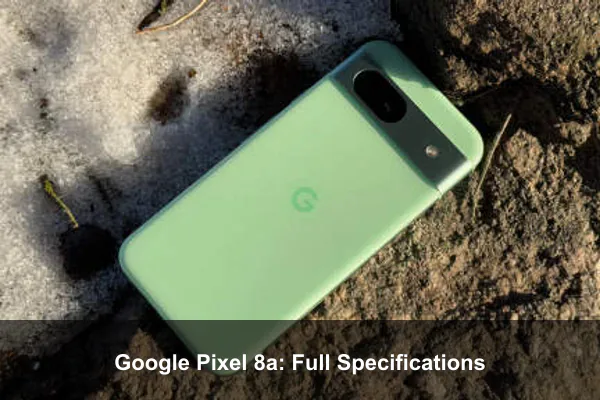
The Google Pixel 8a slots into Google’s affordable A-series as a compact flagship-lite that borrows the brain of its pricier siblings. Announced on 7 May 2024 and released a week later, it pairs the in-house Tensor G3 chipset with a 6.1-inch OLED panel, a clean Pixel software experience, and a promise of seven years of major Android updates that few rivals at this price can match.
What makes the 8a interesting is how much it leans on Google’s photography smarts and long-term support rather than spec-sheet excess. With a 64 MP main camera, IP67 protection, 120Hz display and a 4492 mAh battery, it aims squarely at buyers who want a dependable, software-rich Android phone without paying premium money. This article unpacks where it shines and where the compromises sit.
Full Specifications
Network
| Technology: | GSM / HSPA / LTE / 5G |
| 2G bands: | GSM 850 / 900 / 1800 / 1900 |
| 3G bands: | HSDPA 800 / 850 / 900 / 1700(AWS) / 1900 / 2100 |
| 4G bands: | 1, 2, 3, 4, 5, 7, 8, 12, 17, 18, 19, 20, 26, 28, 32, 38, 40, 41, 42, 66 – G6GPR (International) |
| 1, 2, 3, 4, 5, 7, 8, 12, 13, 14, 17, 20, 25, 26, 28, 29, 30, 38, 41, 48, 66, 71 – G8HHN (USA), GKV4X (NA) | |
| 5G bands: | 1, 2, 3, 5, 7, 8, 12, 20, 26, 28, 38, 40, 41, 66, 75, 76, 77, 78 SA/NSA/Sub6 – G6GPR (International) |
| 1, 2, 3, 5, 7, 8, 12, 20, 25, 26, 28, 29, 30, 38, 41, 48, 66, 70, 71, 77, 78 SA/NSA/Sub6 – GKV4X (NA) | |
| 1, 2, 3, 5, 7, 8, 20, 28, 48, 66, 71, 77, 78, 260, 261 SA/NSA/Sub6/mmWave – G8HHN (USA) | |
| Speed: | HSPA, LTE (CA), 5G |
Launch
| Announced: | 2024, May 07 |
| Status: | Available. Released 2024, May 14 |
Body
| Dimensions: | 152.1 x 72.7 x 8.9 mm (5.99 x 2.86 x 0.35 in) |
| Weight: | 188 g (6.63 oz) |
| Build: | Glass front (Gorilla Glass 3), aluminum frame, plastic back |
| SIM: | Nano-SIM + eSIM |
| IP67 dust/water resistant (up to 1m for 30 min) |
Display
| Type: | OLED, HDR, 120Hz, 2000 nits (peak) |
| Size: | 6.1 inches, 90.3 cm2 (~81.6% screen-to-body ratio) |
| Resolution: | 1080 x 2400 pixels, 20:9 ratio (~430 ppi density) |
| Protection: | Corning Gorilla Glass 3, Mohs level 5 |
Platform
| OS: | Android 14, upgradable to Android 15, up to 7 major Android upgrades |
| Chipset: | Google Tensor G3 (4 nm) |
| CPU: | Nona-core (1×3.0 GHz Cortex-X3 & 4×2.45 GHz Cortex-A715 & 4×2.15 GHz Cortex-A510) |
| GPU: | Immortalis-G715s MC10 |
Memory
| Card slot: | No |
| Internal: | 128GB 8GB RAM, 256GB 8GB RAM |
| UFS 3.1 |
Main Camera
| Dual: | 64 MP (16 MP eff.), f/1.9, 26mm (wide), 1/1.73″, 0.8µm, dual pixel PDAF, OIS 13 MP, f/2.2, 120˚ (ultrawide), 1.12µm |
| Features: | Dual-LED flash, Pixel Shift, Ultra HDR, panorama, Best Take |
| Video: | 4K@30/60fps, 1080p@30/60/120/240fps, OIS |
Selfie camera
| Single: | 13 MP, f/2.2, 20mm (ultrawide), 1.12µm |
| Features: | HDR, panorama |
| Video: | 4K@30fps, 1080p@30/60fps |
Sound
| Loudspeaker: | Yes, with stereo speakers |
| 3.5mm jack: | No |
Comms
| WLAN: | Wi-Fi 802.11 a/b/g/n/ac/6e, dual/tri-band (market/region dependent) |
| Bluetooth: | 5.3, A2DP, LE |
| Positioning: | GPS, GLONASS, GALILEO, BDS, QZSS, NavIC |
| NFC: | Yes |
| Radio: | No |
| USB: | USB Type-C 3.2 |
Features
| Sensors: | Fingerprint (under display, optical), accelerometer, gyro, proximity, compass, barometer |
| Circle to Search |
Battery
| Type: | Li-Po 4492 mAh |
| Charging: | 18W wired, PD3.0 7.5W wireless Bypass charging |
Misc
| Colors: | Obsidian, Porcelain, Bay, Aloe |
| Models: | GKV4X, G6GPR, G8HHN, G576D |
| Price: | € 299.99 / $ 240.00 / £ 239.25 / ₹ 36,999 |
Our Tests
| Performance: | AnTuTu: 1193520 (v10) GeekBench: 4384 (v6) 3DMark: 2427 (Wild Life Extreme) |
| Display: | 1508 nits max brightness (measured) |
| Loudspeaker: | -26.5 LUFS (Good) |
| Battery: | Active use score 11:25h |
| Battery (old): | Endurance rating 83h |
EU LABEL
| Energy: | Class B |
| Battery: | 40:06h endurance, 1000 cycles |
| Free fall: | Class A (270 falls) |
| Repairability: | Class B |
Price and Availability
The Google Pixel 8a offers a compelling combination of features and performance. While the base price is around €300, the actual cost may vary depending on your location and retailer. Below, you’ll find the approximate price of the Google Pixel 8a converted into various currencies. Please note that these are estimates based on recent exchange rates as of June 14, 2026 and may not reflect the exact price you’ll find at a retailer.
- United States: $347
- Japan: ¥55,606
- United Kingdom: £259
- Australia: A$493
- Canada: C$485
- Taiwan: NT$10,968
- Denmark: kr2.238
- Saudi Arabia: ﷼1,301
- South Korea: ₩527,663
- Germany: €300
- Brazil: R$1.769
- Vietnam: ₫9.057.798
- Kenya: KSh 44,930
- India: ₹33,040
- Indonesia: Rp 6.202.460
- Nigeria: ₦467,586
- Pakistan: ₨96,611
- Philippines: ₱21,099
- Bangladesh: ৳৪২,৬৭১
Why the Pixel 8a Is a Strong Value Pick
The Pixel 8a’s biggest selling point is what it inherits from the full Pixel 8 line for less. You get the same Tensor G3 silicon, the same computational photography pipeline, and crucially the same seven years of OS and security updates. That update commitment alone reshapes the value equation: a phone you can realistically keep until 2031 spreads its cost over far more time than most mid-rangers that get two or three years of support. For buyers who keep phones long-term, that longevity is the headline feature.
Design and Build Quality
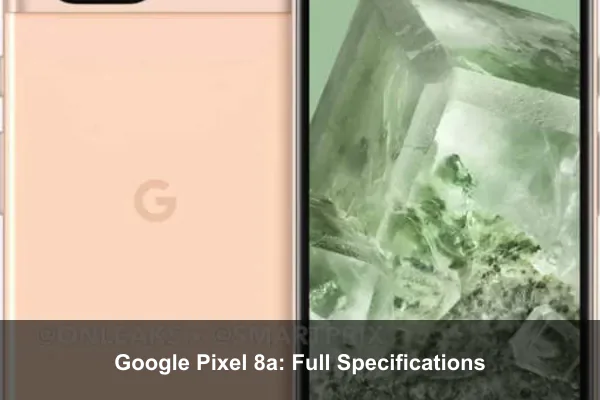
At 152.1 x 72.7 x 8.9 mm and 188 g, the Pixel 8a is genuinely compact by 2024 standards, making it comfortable for one-handed use. The build mixes a Gorilla Glass 3 front and aluminum frame with a plastic back, a sensible cost-saving choice that keeps weight down and durability up. IP67 dust and water resistance is a welcome inclusion at this price, since many competitors skip a formal rating entirely. The four colorways, Obsidian, Porcelain, Bay and Aloe, give the matte rear some personality.
Display Experience
The 6.1-inch OLED runs at a 1080 x 2400 resolution with a 120Hz refresh rate, a step up over many budget panels still stuck at 60Hz or 90Hz. Google quotes 2000 nits peak brightness, and independent measurement landed at roughly 1508 nits, which is more than enough for confident outdoor visibility. HDR support and Gorilla Glass 3 with a Mohs level 5 hardness round out a screen that feels distinctly premium for the category, even if the bezels are a touch thicker than on flagship Pixels.
Performance and Real-World Speed
The Tensor G3 is built on a 4 nm process with a nona-core CPU layout led by a 3.0 GHz Cortex-X3, backed by the Immortalis-G715s MC10 GPU and 8GB of RAM. Benchmark results, an AnTuTu score around 1,193,520 and a GeekBench 6 figure of 4384, place it in solid upper-mid-range territory rather than at the bleeding edge. Where Tensor pulls ahead is on-device AI and Google’s software optimization, so everyday navigation, photo processing and voice features feel snappier than raw numbers suggest. Storage is UFS 3.1 in 128GB or 256GB trims, both with 8GB RAM and no microSD expansion.
Camera Capabilities
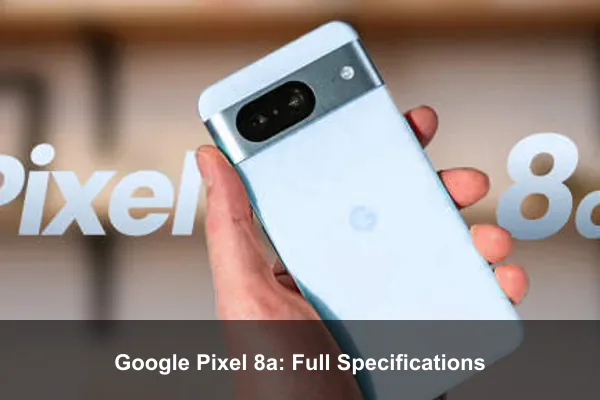
Photography remains the Pixel’s calling card. The dual rear setup pairs a 64 MP f/1.9 main sensor with OIS and dual pixel PDAF alongside a 13 MP ultrawide covering a 120-degree field. Google’s processing brings Ultra HDR, Pixel Shift, Best Take and reliable point-and-shoot consistency, which is where the 8a beats rivals that have better hardware but weaker tuning. Video tops out at 4K 60fps with OIS, and the 13 MP ultrawide selfie camera even captures 4K 30fps, a rarity in this bracket.
Battery Life and Charging
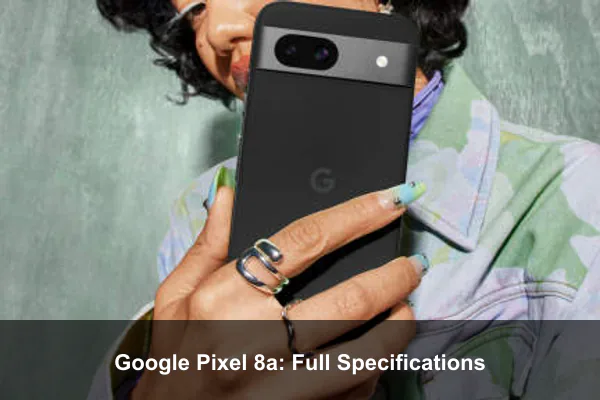
A 4492 mAh Li-Po cell delivers a measured active-use score of around 11 hours 25 minutes, comfortably covering a full day for most users. The trade-off is charging speed: 18W wired and 7.5W wireless are modest, so top-ups take longer than on rivals offering 45W or more. The EU energy label rates battery endurance highly and certifies the cell for 1000 charge cycles, reinforcing the phone’s long-life positioning even if it asks for a little patience at the wall.
Software and Connectivity
The 8a ships on Android 14, upgradable to Android 15, with that standout seven-year upgrade window and exclusive Pixel features like Circle to Search baked in. Connectivity is well covered for the segment: Wi-Fi 6e, Bluetooth 5.3, NFC, USB Type-C 3.2 and broad 5G band support including mmWave on US models. Positioning spans GPS, GLONASS, Galileo, BDS, QZSS and NavIC. The omissions are predictable, no 3.5mm jack, no FM radio and no expandable storage.
Who Should Buy the Pixel 8a
The Pixel 8a suits buyers who prioritize camera quality, clean software and long-term support over fast charging or the highest benchmark scores. It is ideal for anyone wanting a compact phone they can keep for years, photography enthusiasts on a budget, and people invested in Google’s ecosystem. Spec-chasers who want 100W charging or a periscope zoom should look elsewhere, but for balanced, dependable value the 8a is hard to fault.
Conclusion
The Google Pixel 8a is one of the most sensible mid-range buys of its generation, trading flashy charging speeds for a flagship-grade camera, a bright 120Hz OLED, IP67 durability and an unmatched seven-year update promise. If you value longevity, photo consistency and a clean Android experience over raw spec-sheet bragging rights, the Pixel 8a earns a confident recommendation.
