
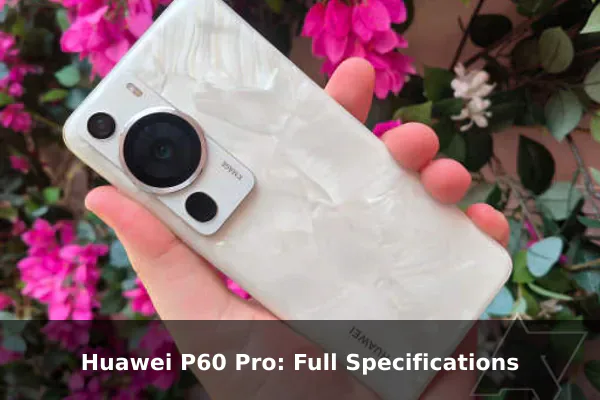
The Huawei P60 Pro is a camera-focused flagship built around a variable-aperture main camera, a high-resolution telephoto system, a bright LTPO OLED display, and fast wired and wireless charging. It sits in an interesting position today because it brings premium hardware and strong imaging credentials while staying limited to 4G connectivity.
This article looks at the Huawei P60 Pro from a practical specs perspective: what still feels flagship-grade, where the trade-offs matter, and who should consider it over newer 5G alternatives. A separate full specifications table will cover every raw hardware detail.
Full Specifications
Network
| Technology: | GSM / CDMA / HSPA / CDMA2000 / LTE |
| 2G bands: | GSM 850 / 900 / 1800 / 1900 |
| CDMA 800 | |
| 3G bands: | HSDPA 800 / 850 / 900 / 1700(AWS) / 1900 / 2100 |
| CDMA2000 1x | |
| 4G bands: | 1, 2, 3, 4, 5, 7, 8, 12, 13, 17, 18, 19, 20, 26, 28, 32, 34, 38, 39, 40, 41, 66 – International |
| 1, 2, 3, 4, 5, 7, 8, 12, 17, 18, 19, 20, 26, 28, 34, 38, 39, 40, 41 – China | |
| Speed: | HSPA, LTE |
Launch
| Announced: | 2023, March 23 |
| Status: | Available. Released 2023, March 31 |
Body
| Dimensions: | 161 x 74.5 x 8.3 mm (6.34 x 2.93 x 0.33 in) |
| Weight: | 200 g (7.05 oz) |
| SIM: | Nano-SIMNano-SIM + Nano-SIM |
| IP68 dust tight and water resistant (immersible up to 1.5m for 30 min) |
Display
| Type: | LTPO OLED, 1B colors, 120Hz |
| Size: | 6.67 inches, 107.7 cm2 (~89.8% screen-to-body ratio) |
| Resolution: | 1220 x 2700 pixels (~444 ppi density) |
| Protection: | Kunlun Glass |
Platform
| OS: | HarmonyOS 3.1 (China), EMUI 13.1 (Europe), no Google Play Services |
| Chipset: | Qualcomm SM8475 Snapdragon 8+ Gen 1 4G (4 nm) |
| CPU: | Octa-core (1×3.19 GHz Cortex-X2 & 3×2.75 GHz Cortex-A710 & 4×2.0 GHz Cortex-A510) |
| GPU: | Adreno 730 |
Memory
| Card slot: | Nano Memory (uses shared SIM slot) |
| Internal: | 256GB 8GB RAM, 256GB 12GB RAM, 512GB 12GB RAM |
| UFS |
Main Camera
| Triple: | 48 MP, f/1.4-f/4.0, 25mm (wide), PDAF, OIS 48 MP, f/2.1, 90mm (telephoto), PDAF, sensor-shift OIS, 3.5x optical zoom 13 MP, f/2.2, 13mm (ultrawide), AF |
| Features: | Laser AF, color spectrum sensor, LED flash, HDR, panorama |
| Video: | 4K@30/60fps, 1080p@30/60fps, 1080p@960fps; gyro-EIS, HDR Vivid |
Selfie camera
| Single: | 13 MP, f/2.4, (ultrawide) |
| Features: | Panorama, HDR |
| Video: | 4K@30/60fps, 1080p@30fps, HDR Vivid |
Sound
| Loudspeaker: | Yes, with stereo speakers |
| 3.5mm jack: | No |
Comms
| WLAN: | Wi-Fi 802.11 a/b/g/n/ac/6, dual-band, Wi-Fi Direct |
| Bluetooth: | 5.2, A2DP, LE |
| Positioning: | GPS (L1+L5), GLONASS (B1I+B1c+B2a), BDS (B1I+B1c+B2a), GALILEO (E1+E5a), QZSS (L1+L5), NavIC |
| NFC: | Yes |
| Infrared port: | Yes |
| Radio: | No |
| USB: | USB Type-C 3.1, OTG |
Features
| Sensors: | Fingerprint (under display, optical), accelerometer, gyro, proximity, compass |
| BDS Satellite Messaging – China only |
Battery
| Type: | Li-Po 4815 mAh |
| Charging: | 88W wired 50W wireless Reverse wireless |
Misc
| Colors: | Black, Green, Violet, Rococo Pearl |
| Models: | MNA-AL00, MNA-LX9 |
| Price: | € 482.80 |
Our Tests
| Performance: | AnTuTu: 1030473 (v9) GeekBench: 4422 (v6) GFXBench: 65fps (ES 3.1 onscreen) |
| Display: | 1135 nits max brightness (measured) |
| Camera: | Photo / Video |
| Loudspeaker: | -27.3 LUFS (Good) |
| Battery (old): | Endurance rating 96h |
Price and Availability
The Huawei P60 Pro offers a compelling combination of features and performance. While the base price is around €483, the actual cost may vary depending on your location and retailer. Below, you’ll find the approximate price of the Huawei P60 Pro converted into various currencies. Please note that these are estimates based on recent exchange rates as of August 29, 2026 and may not reflect the exact price you’ll find at a retailer.
- United States: $561
- Japan: ¥89,588
- United Kingdom: £413
- Australia: A$781
- Canada: C$778
- Taiwan: NT$17,731
- Denmark: kr3.609
- Saudi Arabia: ﷼2,102
- South Korea: ₩772,839
- Germany: €483
- Brazil: R$2.901
- Vietnam: ₫14.499.895
- Kenya: KSh 72,781
- India: ₹53,532
- Indonesia: Rp 9.896.907
- Nigeria: ₦764,836
- Pakistan: ₨155,498
- Philippines: ₱34,899
- Bangladesh: ৳৬৮,৯৯৮
Value Perspective
The Huawei P60 Pro is not a typical current flagship purchase. Its appeal is less about owning the newest chipset or modem and more about getting a premium Huawei camera phone at a potentially lower market price than launch-era flagships. The listed source price of €482.80 places it in a competitive range where many newer midrange phones offer 5G, but fewer match its combination of optical telephoto hardware, fast wireless charging, IP68 protection, and flagship display quality.
The main value question is whether you prioritize camera hardware and premium construction over Google services and 5G. For buyers who are comfortable with Huawei’s software environment, the P60 Pro can still look compelling. For users who rely heavily on Google Play, Android Auto, Google Wallet, or carrier 5G, the value equation becomes more complicated.
Design and Durability
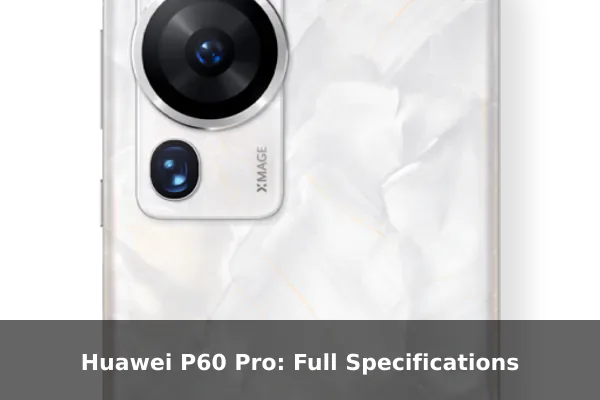
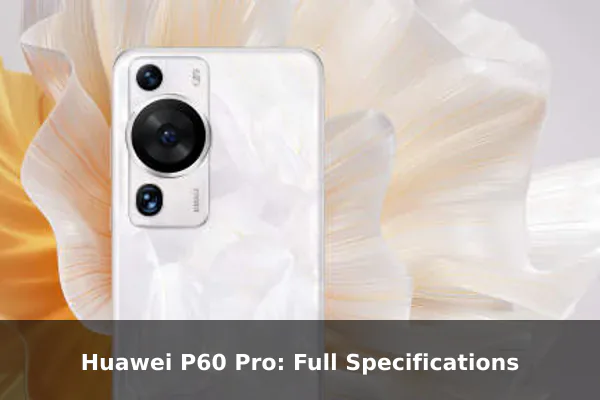
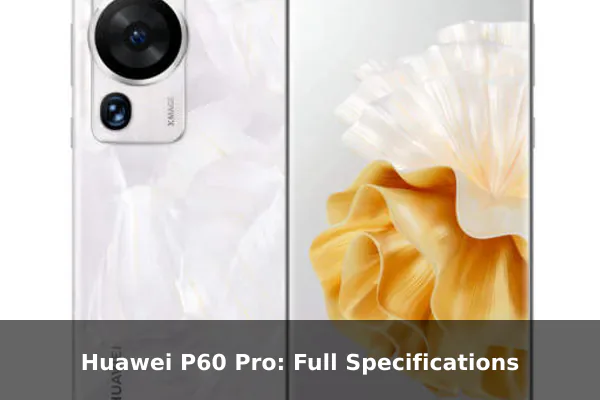
Huawei gave the P60 Pro a polished flagship body with a relatively slim 8.3 mm profile and a 200 g weight. That makes it substantial without being unusually heavy for a large-screen premium phone. The curved display edges and distinctive rear camera arrangement help it stand apart from more conventional slab designs, especially in the Rococo Pearl finish.
Durability is one of its stronger practical points. The phone carries IP68 dust and water resistance, rated for immersion up to 1.5 meters for 30 minutes under specified test conditions. Kunlun Glass protection also gives the display side an additional durability claim from Huawei, though real-world drop survival always depends on impact angle, surface, and case use.
Display Quality
The 6.67-inch LTPO OLED display is one of the clearest reasons the P60 Pro still feels high-end. It supports 1 billion colors, a 120Hz refresh rate, and a sharp 1220 x 2700 pixel resolution at around 444 ppi. That puts it above many standard Full HD panels and makes text, camera previews, and high-resolution images look crisp.
The measured 1135 nits maximum brightness from the test data suggests strong outdoor usability, even if newer flagship screens may go brighter in specific HDR or sunlight boost modes. The LTPO panel also helps with refresh-rate flexibility, which can balance smooth scrolling with power efficiency depending on content.
Performance and Hardware
The Snapdragon 8+ Gen 1 4G remains a powerful chipset. Its Cortex-X2 prime core, Cortex-A710 performance cores, Cortex-A510 efficiency cores, and Adreno 730 GPU are still capable of demanding apps, advanced camera processing, and gaming at high settings. The important detail is the 4G suffix: this version does not provide 5G connectivity.
Performance test figures reinforce that it is still a flagship-class device for everyday use. The listed AnTuTu v9 score of 1,030,473, GeekBench v6 score of 4,422, and GFXBench result of 65fps indicate plenty of headroom for multitasking and graphics-heavy workloads. Storage options up to 512GB with 12GB RAM also help keep the phone relevant for heavier users.
Camera System
The camera setup is the P60 Pro’s headline feature. The 48 MP main camera uses a variable f/1.4-f/4.0 aperture, optical image stabilization, and phase detection autofocus, giving it more flexibility than a fixed-aperture sensor in changing light. A wider aperture can help with night scenes and subject separation, while a narrower aperture can help keep more of a scene in focus.
The 48 MP telephoto camera is another major strength, offering a 90 mm equivalent view, 3.5x optical zoom, PDAF, and sensor-shift OIS. That makes it more serious for portraits, stage shots, architecture, and travel details than phones that rely mainly on digital zoom. The 13 MP ultrawide camera rounds out the system with autofocus, while Laser AF, a color spectrum sensor, HDR, panorama, and 4K video support add to its versatility.
Selfie and Video Use
The 13 MP ultrawide selfie camera is useful for group shots, travel photos, and video calls where a wider field of view matters. It supports HDR and panorama modes, plus video recording up to 4K at 30 or 60fps. That is a stronger front-camera video specification than many midrange phones in the same resale or discounted price band.
Rear video is also well covered with 4K at 30 or 60fps, 1080p at standard frame rates, 1080p slow motion up to 960fps, gyro-EIS, and HDR Vivid. Users focused mainly on social video should still check app compatibility on Huawei’s software platform, because camera quality inside third-party apps can vary from the native camera experience.
Battery and Charging
The 4815 mAh battery is not the largest in today’s market, but it is paired with efficient flagship hardware and an LTPO display. The listed endurance rating of 96 hours points to solid all-round battery life for mixed use, though heavy camera, navigation, gaming, and hotspot use will drain it faster.
Charging is a major advantage. The P60 Pro supports 88W wired charging, 50W wireless charging, and reverse wireless charging. That makes it more flexible than many phones that either omit wireless charging entirely or limit it to much slower speeds. For desk, car, and travel use, the charging package remains genuinely premium.
Software and Connectivity Trade-Offs
Software is the main area buyers need to evaluate carefully. The phone ships with HarmonyOS 3.1 in China and EMUI 13.1 in Europe, with no Google Play Services. That does not make the phone unusable, but it does change the app experience. Users may need Huawei AppGallery, web apps, or alternative app installation methods, and some banking, payment, work, or smart-home apps may not behave the same as they do on Google-certified Android phones.
Connectivity is broad but not future-facing in every respect. The P60 Pro supports GSM, CDMA, HSPA, CDMA2000, and LTE, along with Wi-Fi 6, Bluetooth 5.2, NFC, infrared, USB-C 3.1, and extensive satellite positioning systems. The China-only BDS Satellite Messaging feature is notable, but international buyers should not assume that function will be available in their region. The absence of 5G is the biggest network limitation.
Who Should Buy the Huawei P60 Pro?
The Huawei P60 Pro is best for photography-first buyers who want a premium camera phone with strong zoom capability, a bright high-resolution OLED screen, IP68 protection, and fast wired plus wireless charging. It also suits users already familiar with Huawei’s ecosystem or those who do not depend heavily on Google services.
It is less suitable for buyers who want a simple Google-first Android experience, long-term 5G readiness, or the newest flagship processor. In that case, a newer 5G Android flagship or upper-midrange phone may be easier to live with, even if its camera hardware is less ambitious.
Conclusion
The Huawei P60 Pro remains a distinctive flagship because it focuses on camera flexibility, premium display quality, durable design, and fast charging rather than chasing 5G. Its variable-aperture main camera and stabilized telephoto lens are still meaningful advantages, but the lack of Google Play Services and 5G should be considered before buying. Recommended for camera-focused users who are comfortable with Huawei software and want flagship hardware at a more accessible price.
References
- HUAWEI P60 Pro – HUAWEI UK – Official English Huawei product page with the device's core features, camera claims, display, charging, battery, durability notes, and manufacturer footnotes.
- HUAWEI P60 Pro Specifications – HUAWEI Peru – Official Huawei specification table for dimensions, display, processor, memory, cameras, battery, connectivity, and other hardware details.
- Snapdragon 8+ Gen 1 Mobile Platform – Qualcomm – Official chipset manufacturer source for Snapdragon 8+ Gen 1 CPU, GPU, process, wireless, AI, ISP, and platform capabilities.
- Huawei P60 Pro Camera Test – DXOMARK – Recognized independent lab source for camera hardware summary and tested camera performance details.
- Huawei P60 Pro Full Specifications – PhoneArena – Established phone reference site useful for cross-checking release timing, variants, cellular bands, connectivity, and consolidated specifications.
