
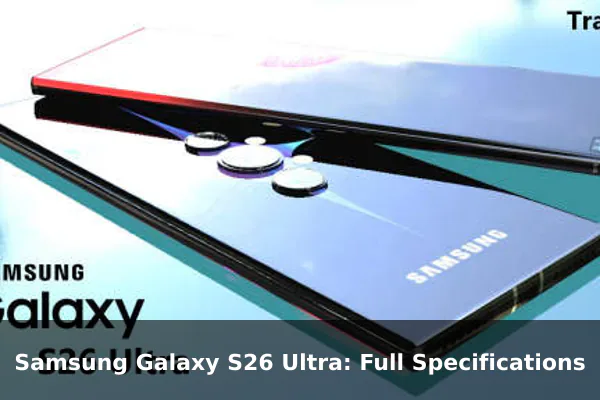
Samsung Galaxy S26 Ultra is positioned as Samsung’s next top-tier Ultra phone, built around a large 6.9-inch LTPO AMOLED display, titanium construction, S Pen support, and a quad-camera system led by a 200 MP main sensor.
The available source data presents the phone as a rumored model, so this article focuses on the listed specifications without inventing missing launch, pricing, or regional availability details.
Full Specifications
Network
| Technology: | GSM / CDMA / HSPA / EVDO / LTE / 5G |
| 2G bands: | GSM 850 / 900 / 1800 / 1900 |
| CDMA 800 / 1900 & TD-SCDMA | |
| 3G bands: | HSDPA 850 / 900 / 1700(AWS) / 1900 / 2100 |
| CDMA2000 1xEV-DO | |
| 4G bands: | LTE |
| 5G bands: | SA/NSA/Sub6 – International |
| SA/NSA/Sub6/mmWave – USA unlocked | |
| Speed: | HSPA, LTE (up to 7CA), 5G |
Launch
| Announced: | Not announced yet |
| Status: | Rumored |
Body
| Dimensions: | 7.9 mm thickness |
| Weight: | 214 g (7.55 oz) |
| Build: | Glass front (Corning Gorilla Armor 2), glass back (Gorilla Glass Victus 2), titanium frame (grade 5) |
| SIM: | · Nano-SIM + Nano-SIM + eSIM + eSIM (max 2 at a time) – INT· Nano-SIM + eSIM + eSIM (max 2 at a time) – USA· Nano-SIM + Nano-SIM – CN |
| IP68 dust tight and water resistant (immersible up to 1.5m for 30 min) Stylus |
Display
| Type: | Dynamic LTPO AMOLED 2X, 120Hz, HDR10+, 2600 nits (peak) |
| Size: | 6.9 inches, 116.9 cm2 |
| Resolution: | 1440 x 3120 pixels, 19.5:9 ratio (~498 ppi density) |
| Protection: | Corning Gorilla Armor 2 |
| DX anti-reflective coating |
Platform
| OS: | Android 16, up to 7 major Android upgrades, One UI 8 |
| Chipset: | Qualcomm SM8850-AC Snapdragon 8 Elite Gen 5 (3 nm) |
| CPU: | Octa-core (2×4.6 GHz Oryon V3 Phoenix L + 6×3.62 GHz Oryon V3 Phoenix M) |
| GPU: | Adreno 840 |
Memory
| Card slot: | No |
| Internal: | 256GB 12GB RAM, 512GB 12GB RAM, 1TB 12GB RAM, 1TB 16GB RAM |
| UFS 4.0 |
Main Camera
| Quad: | 200 MP, f/1.7, 24mm (wide), 1/1.3″, 0.6µm, multi-directional PDAF, OIS 10 MP, (telephoto), 1/3.94″, PDAF, OIS, 3x optical zoom 50 MP, f/3.4, 111mm (periscope telephoto), 1/2.52″, 0.7µm, PDAF, OIS, 5x optical zoom 50 MP, f/1.9, 120˚ (ultrawide), 1/2.5″, 0.7µm, dual pixel PDAF, Super Steady video |
| Features: | Laser AF, Best Face, LED flash, auto-HDR, panorama |
| Video: | 8K@24/30fps, 4K@30/60/120fps, 1080p@30/60/120/240fps, 10-bit HDR, HDR10+, stereo sound rec., gyro-EIS |
Selfie camera
| Single: | 12 MP, f/2.2, 26mm (wide), 1/3.2″, 1.12µm, dual pixel PDAF |
| Features: | HDR, HDR10+ |
| Video: | 4K@30/60fps, 1080p@30fps |
Sound
| Loudspeaker: | Yes, with stereo speakers |
| 3.5mm jack: | No |
| High-bitrate audio support |
Comms
| WLAN: | Wi-Fi 802.11 a/b/g/n/ac/6e/7, tri-band, Wi-Fi Direct |
| Bluetooth: | 5.4, A2DP, LE |
| Positioning: | GPS, GLONASS, BDS, GALILEO, QZSS |
| NFC: | Yes |
| Radio: | No |
| USB: | USB Type-C 3.2, DisplayPort 1.2, OTG |
Features
| Sensors: | Fingerprint (under display, ultrasonic), accelerometer, gyro, proximity, compass, barometer |
| Samsung DeX, Samsung Wireless DeX (desktop experience support) Ultra Wideband (UWB) support |
Battery
| Type: | Li-Ion 5000 mAh |
| Charging: | 60W wired, PD3.0 15W wireless (Qi2 Ready) 4.5W reverse wireless |
Misc
| Colors: | Black; other colors |
Why Should You Buy Samsung Galaxy S26 Ultra?
The Samsung Galaxy S26 Ultra is aimed at buyers who want the most complete Galaxy-style flagship rather than a compact or value-focused phone. Its appeal comes from the combination of a huge high-resolution display, stylus support, premium materials, long software support, a 200 MP camera system, and high-end wireless features such as Wi-Fi 7 and Ultra Wideband. It is not just a performance phone on paper; it is shaped more like a productivity, camera, and media device for users who expect one phone to cover several roles.
Because the listed status is still rumored, the strongest way to evaluate it is by looking at the balance of the specification sheet. The phone appears to prioritize durability, screen quality, camera versatility, and long-term usability over extreme battery capacity or expandable storage. That makes it a good fit for users comparing it with other premium Android flagships, especially those who care about display sharpness, zoom camera flexibility, and desktop-style features such as Samsung DeX.
Design And Build Quality
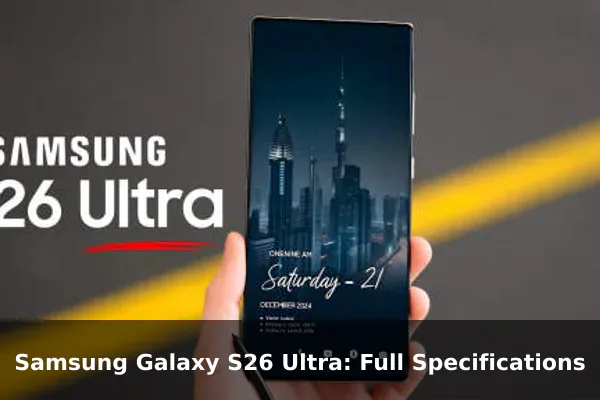
The listed body details point to a thin but substantial device. At 7.9 mm thick and 214 g, the Galaxy S26 Ultra would not be a small phone, but the weight is reasonable for a large-screen Ultra model with a titanium frame. The use of Corning Gorilla Armor 2 on the front, Gorilla Glass Victus 2 on the back, and grade 5 titanium gives the phone a clearly premium hardware profile.
The IP68 rating is another practical advantage, covering dust resistance and water immersion up to 1.5 meters for 30 minutes under specified test conditions. The built-in stylus remains one of the Ultra line’s most distinctive features, making the phone more useful for note-taking, markup, document review, and quick sketches than typical slab flagships.
Display Experience
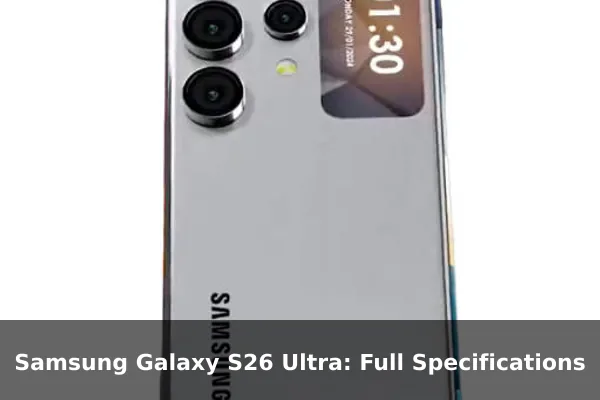
The 6.9-inch Dynamic LTPO AMOLED 2X display is one of the headline specifications. With a 1440 x 3120 pixel resolution, a 19.5:9 aspect ratio, and about 498 ppi density, the panel is designed for sharp text, detailed photos, and comfortable multitasking. The LTPO technology also matters because it allows the display to vary its refresh rate more efficiently than a fixed high-refresh panel.
The 120Hz refresh rate should help scrolling and animation feel smooth, while HDR10+ support and a listed 2600-nit peak brightness make the screen well suited for video and outdoor use. The DX anti-reflective coating is especially relevant for an Ultra device, because visibility in bright environments can matter as much as raw brightness.
Performance And Storage
The source sheet lists the Qualcomm SM8850-AC Snapdragon 8 Elite Gen 5 built on a 3 nm process, paired with an octa-core CPU using two high-performance Oryon V3 Phoenix L cores and six Oryon V3 Phoenix M cores. Together with the Adreno 840 GPU, this places the Galaxy S26 Ultra firmly in flagship territory for gaming, editing, AI-assisted features, and demanding multitasking.
Storage options start at 256GB with 12GB RAM and rise to 512GB 12GB RAM, 1TB 12GB RAM, and 1TB 16GB RAM. UFS 4.0 storage should help with app loading, file transfers, camera capture, and general responsiveness. The trade-off is that there is no card slot, so buyers should choose storage carefully at purchase, especially if they shoot a lot of 4K or 8K video.
Camera System
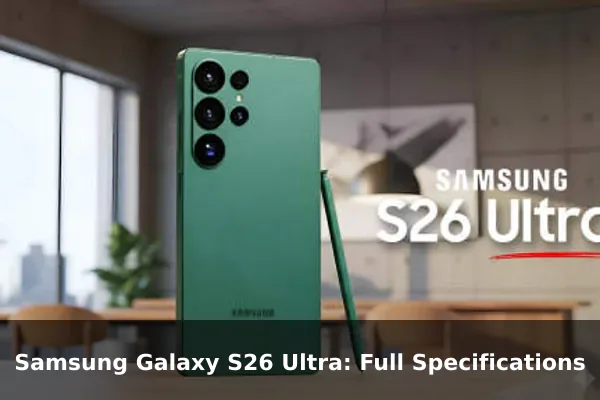
The rear camera setup is built around flexibility. The listed quad-camera array includes a 200 MP wide camera with OIS, a 10 MP telephoto camera with 3x optical zoom, a 50 MP periscope telephoto camera with 5x optical zoom, and a 50 MP ultrawide camera with dual pixel PDAF. This gives the phone meaningful coverage from wide landscapes to portraits and longer zoom shots.
Video is also a major part of the specification sheet. The phone is listed with 8K recording at 24 or 30 fps, 4K at up to 120 fps, and 1080p at up to 240 fps, plus 10-bit HDR, HDR10+, stereo sound recording, and gyro-EIS. The 12 MP selfie camera is more modest in resolution, but dual pixel PDAF and 4K video at 30 or 60 fps make it suitable for video calls, social clips, and front-facing recording.
Battery And Charging
The 5000 mAh battery is a familiar capacity for a large Android flagship. It should be enough for demanding daily use, although final endurance will depend on display brightness, 5G use, camera recording, gaming, and software tuning. The large high-resolution display and high-end chipset mean efficiency will matter as much as capacity.
Charging support is listed as 60W wired with PD3.0, 15W wireless with Qi2 Ready support, and 4.5W reverse wireless charging. That is a practical mix: wired charging should be useful for quick top-ups, wireless charging adds desk or bedside convenience, and reverse wireless charging can help with earbuds or accessories in a pinch.
Software And Long-Term Support
The software section lists Android 16 with One UI 8 and up to seven major Android upgrades. If delivered as stated, that would make the Galaxy S26 Ultra a strong long-term ownership option for buyers who keep phones for several years. Long update support is particularly valuable on an expensive flagship because it helps preserve security, feature access, and resale value.
Samsung DeX and Wireless DeX also strengthen the productivity angle. These features let the phone act more like a desktop-style device when connected to a display, keyboard, and mouse. For business users, students, and frequent travelers, that can reduce the need to carry a laptop for lighter workflows.
Connectivity And Regional Notes
The network support is broad, covering GSM, CDMA, HSPA, EVDO, LTE, and 5G. The source separates international Sub6 5G from the USA unlocked model, which is listed with both Sub6 and mmWave. That regional difference matters because mmWave availability and usefulness depend heavily on carrier and location.
Other connectivity features include Wi-Fi 802.11 a/b/g/n/ac/6e/7, tri-band Wi-Fi, Bluetooth 5.4, NFC, GPS with multiple satellite systems, USB Type-C 3.2, DisplayPort 1.2, OTG, and UWB support. There is no 3.5mm headphone jack and no radio, but stereo speakers and high-bitrate audio support help keep the media experience competitive.
Who Should Buy It?
The Galaxy S26 Ultra makes the most sense for power users who want a large premium Android phone with a stylus, a very sharp display, strong zoom cameras, advanced video options, and desktop-style productivity tools. It should also appeal to Samsung users who are upgrading from an older Ultra model and want improved performance, connectivity, and software longevity.
It is less ideal for buyers who prefer compact phones, microSD expansion, a headphone jack, or a lower price point. Since no exact price is included in the supplied source data, value will depend heavily on final market pricing, launch offers, storage tier, and carrier bundles.
References
References used for context: the supplied source catalog at tampungspekhp.berkasdrive.com, Samsung’s official Galaxy S26 Ultra product page, Samsung Newsroom’s Galaxy S26 series announcement, and Qualcomm’s Snapdragon 8 Elite Gen 5 for Galaxy press release.
Conclusion
Samsung Galaxy S26 Ultra reads like a fully loaded Ultra-class flagship: large anti-reflective AMOLED display, titanium build, S Pen support, Snapdragon flagship silicon, versatile cameras, DeX, UWB, and long software support. Based on the listed specifications, it is best recommended for users who want Samsung’s most capable productivity and camera phone rather than a compact or budget-friendly device.
