
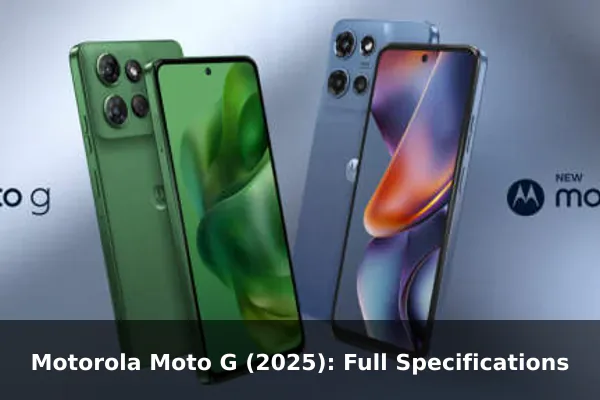
The Motorola Moto G (2025) is a budget 5G Android phone built around a large 120Hz display, a 5000mAh battery, stereo speakers, expandable storage, and a 50MP main camera with optical image stabilization. It sits in the practical end of Motorola’s lineup, where everyday usability matters more than premium materials or flagship-grade resolution.
Announced on January 14, 2025 and released on January 30, 2025, this model is aimed at buyers who want modern network support and dependable core features without moving into mid-range pricing. The official Motorola product and support pages, Motorola’s launch announcement, and FCC documentation are useful anchors for checking its hardware, connectivity, and availability details.
Full Specifications
Network
| Technology: | GSM / HSPA / LTE / 5G |
| 2G bands: | GSM 850 / 900 / 1800 / 1900 |
| 3G bands: | HSDPA 850 / 900 / 1700(AWS) / 1900 / 2100 |
| 4G bands: | 1, 2, 3, 4, 5, 7, 8, 12, 13, 14, 17, 18, 20, 25, 26, 28, 29, 30, 38, 39, 40, 41, 48, 66, 71 |
| 5G bands: | 2, 5, 7, 12, 14, 25, 26, 29, 30, 41, 48, 66, 70, 71, 77, 78 SA/NSA/Sub6 |
| Speed: | HSPA, LTE, 5G |
Launch
| Announced: | 2025, January 14 |
| Status: | Available. Released 2025, January 30 |
Body
| Dimensions: | 167.1 x 76.3 x 8.2 mm (6.58 x 3.00 x 0.32 in) |
| Weight: | 193 g (6.81 oz) |
| Build: | Glass front (Gorilla Glass 3), silicone polymer (eco leather) back, plastic frame |
| SIM: | Nano-SIM + eSIM |
| Water-repellent design |
Display
| Type: | IPS LCD, 120Hz |
| Size: | 6.7 inches, 108.2 cm2 (~84.9% screen-to-body ratio) |
| Resolution: | 720 x 1604 pixels, 20:9 ratio (~262 ppi density) |
| Protection: | Corning Gorilla Glass 3 |
Platform
| OS: | Android 15, up to 2 major Android upgrades |
| Chipset: | Mediatek Dimensity 6300 (6 nm) |
| CPU: | Octa-core (2×2.4 GHz Cortex-A76 & 6×2.0 GHz Cortex-A55) |
| GPU: | Mali-G57 MC2 |
Memory
| Card slot: | microSDXC (dedicated slot) |
| Internal: | 64GB 4GB RAM, 128GB 4GB RAM |
Main Camera
| Dual: | 50 MP, f/1.8, (wide), 0.61µm, PDAF, OIS 2 MP, f/2.4, (macro) |
| Features: | LED flash, HDR, panorama |
| Video: | 1080p@30fps |
Selfie camera
| Single: | 16 MP, f/2.4, (wide), 1.0µm |
| Video: | 1080p@30fps |
Sound
| Loudspeaker: | Yes, with stereo speakers (with Dolby Atmos) |
| 3.5mm jack: | Yes |
Comms
| WLAN: | Wi-Fi 802.11 a/b/g/n/ac, dual-band |
| Bluetooth: | Yes |
| Positioning: | GPS, GALILEO, GLONASS |
| NFC: | Yes |
| Radio: | Unspecified |
| USB: | USB Type-C 2.0 |
Features
| Sensors: | Fingerprint (side-mounted), accelerometer, gyro, proximity, compass, barometer |
Battery
| Type: | 5000 mAh |
| Charging: | 30W wired |
Misc
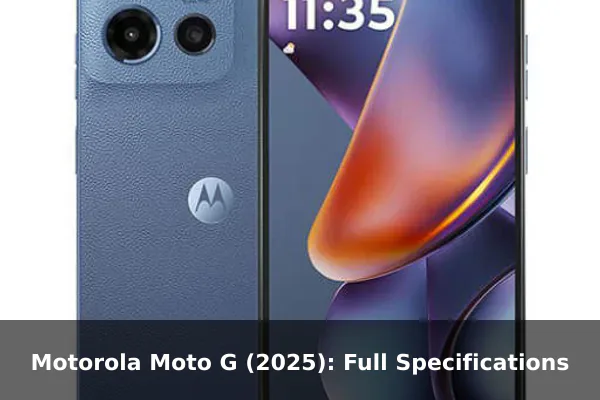
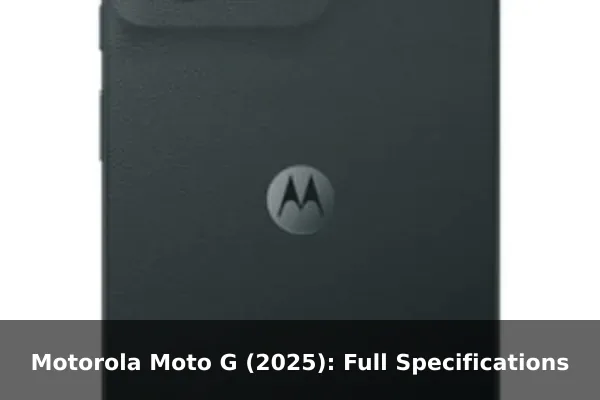
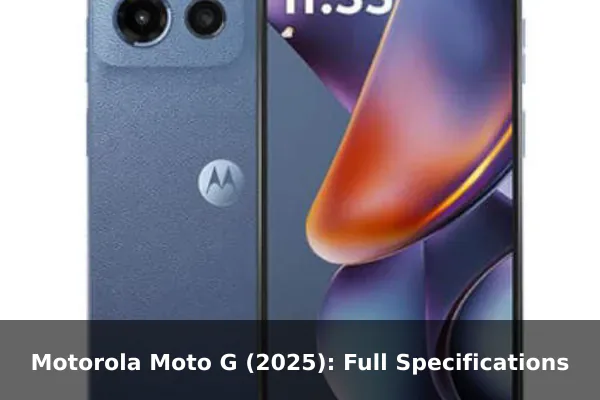
| Colors: | Forest Gray, Sapphire Blue |
| Price: | $ 174.90 |
Price and Availability
The Motorola Moto G (2025) offers a compelling combination of features and performance. While the base price is around $175, the actual cost may vary depending on your location and retailer. Below, you’ll find the approximate price of the Motorola Moto G (2025) converted into various currencies. Please note that these are estimates based on recent exchange rates as of September 29, 2026 and may not reflect the exact price you’ll find at a retailer.
- United States: $175
- Japan: ¥27,514
- United Kingdom: £132
- Australia: A$249
- Canada: C$248
- Taiwan: NT$5,564
- Denmark: kr1.149
- Saudi Arabia: ﷼656
- South Korea: ₩237,684
- Germany: €154
- Brazil: R$911
- Vietnam: ₫4.532.958
- Kenya: KSh 22,658
- India: ₹16,803
- Indonesia: Rp 3.145.536
- Nigeria: ₦232,508
- Pakistan: ₨48,441
- Philippines: ₱10,931
- Bangladesh: ৳২১,৫২২
Value Positioning
The strongest argument for the Motorola Moto G (2025) is its balance of modern essentials. It offers 5G, Android 15, a high-refresh display, a large battery, NFC, microSD expansion, a headphone jack, stereo speakers with Dolby Atmos, and a stabilized main camera. That combination is especially relevant for buyers replacing an older LTE-only phone or a low-storage handset. The phone does not chase premium extras, but it covers the features people notice every day: smoother scrolling, reliable endurance, flexible storage, tap-to-pay support, and a familiar Android experience.
Its value also depends on expectations. The 720 x 1604 pixel display resolution and 4GB RAM configurations show that this is not designed to compete with performance-focused mid-range phones. Instead, it makes more sense as an affordable daily phone for calls, messaging, maps, streaming, light gaming, social apps, and casual photography. For that role, the Moto G (2025) has a sensible spec mix.
Design and Durability
Motorola gives the Moto G (2025) a large but manageable body at 167.1 x 76.3 x 8.2 mm, with a weight of 193 g. The front uses Gorilla Glass 3, the frame is plastic, and the back is listed as silicone polymer with an eco leather finish. That back material helps separate it from many glossy budget phones, giving it a softer feel and a more grip-friendly surface.
The phone also has a water-repellent design, which is useful for minor splashes and daily exposure. It should not be treated as a fully waterproof phone, because no formal IP water-resistance rating is listed in the provided specification data. The Forest Gray and Sapphire Blue color options keep the design simple, while the side-mounted fingerprint reader keeps unlocking fast and easy to reach.
Display Experience
The 6.7-inch IPS LCD is one of the phone’s headline features because it supports a 120Hz refresh rate. That matters for scrolling through apps, browsing long pages, and moving around the interface, where a faster refresh rate can make the phone feel more responsive than a basic 60Hz panel. The large size also suits video, reading, and navigation.
The trade-off is resolution. At 720 x 1604 pixels and about 262 ppi, the screen is not as sharp as Full HD panels found on some more expensive phones. Text, icons, and fine detail may look less crisp if you are used to denser displays. Still, for users who care more about size, smoothness, and battery-friendly operation than pixel density, the display choice is understandable.
Performance and Storage
The Mediatek Dimensity 6300 chipset gives the Moto G (2025) its 5G foundation and should be suitable for everyday Android use. Its octa-core CPU combines two Cortex-A76 cores for heavier bursts with six Cortex-A55 cores for lighter background work, while the Mali-G57 MC2 handles graphics. This is a practical entry-level 5G platform rather than a gaming-first chip.
Motorola lists 64GB and 128GB internal storage versions, both paired with 4GB RAM. The dedicated microSDXC slot is important because it lets users add storage without giving up the SIM arrangement. For buyers who keep many photos, videos, downloads, or offline music files, the 128GB version is the more comfortable pick, while the 64GB model works best with cloud storage and lighter app use.
Camera Setup
The rear camera system is led by a 50MP wide camera with PDAF and OIS. Optical image stabilization is a valuable inclusion at this level because it can help reduce blur from hand movement and improve consistency in lower-light scenes. The camera supports HDR, panorama, LED flash, and 1080p video recording at 30fps.
The second rear camera is a 2MP macro unit. It adds a close-up shooting mode, but buyers should see the 50MP stabilized main camera as the real focus of the system. On the front, the 16MP selfie camera records up to 1080p at 30fps, which is enough for video calls, short clips, and social posting, though there is no indication of advanced selfie hardware beyond the listed wide camera.
Battery and Charging
A 5000mAh battery gives the Moto G (2025) the kind of capacity buyers expect from a practical budget phone. Combined with a 720p-class display and efficient chipset, it should be positioned for long everyday use, although actual endurance will depend on signal strength, brightness, app load, and 5G usage.
The 30W wired charging support is also welcome in this segment. It is not the fastest charging available in Android phones, but it is meaningfully better than very slow entry-level charging speeds. For people who charge during the morning routine or between outings, 30W wired support makes the phone easier to live with.
Software Experience
The Moto G (2025) ships with Android 15 and is listed with up to two major Android upgrades. That gives it a clear software path beyond launch, which matters for buyers who plan to keep a phone for several years. Motorola’s support pages are also useful references for checking device behavior, ports, controls, and software-related details after purchase.
As with any Android phone, update timing can vary by region, carrier, and model variant. The important point is that Motorola is positioning the phone with a defined upgrade promise, which improves confidence compared with devices where major software support is unclear.
Connectivity and Everyday Features
Connectivity is one of the Moto G (2025)’s most complete areas. It supports GSM, HSPA, LTE, and 5G, with Sub-6 SA and NSA 5G bands listed. The LTE and 5G band coverage is broad, and the FCC listing helps verify the device’s radio technologies and model variants. For a budget-focused phone, this is a major practical strength.
The rest of the feature set is similarly useful: dual-band Wi-Fi ac, Bluetooth, GPS with GALILEO and GLONASS, NFC, USB Type-C 2.0, a 3.5mm headphone jack, stereo speakers with Dolby Atmos, and sensors including a side fingerprint reader, accelerometer, gyro, proximity sensor, compass, and barometer. The Nano-SIM + eSIM setup also gives buyers more carrier flexibility than a physical SIM-only design.
Who Should Buy It?
The Motorola Moto G (2025) is best for buyers who want a current Android phone with 5G, strong battery capacity, expandable storage, NFC, and a large smooth display at a budget-friendly level. It is a sensible upgrade from older Moto G models, aging LTE phones, or devices with weak battery life and limited storage.
It is less ideal for users who prioritize a very sharp display, heavy multitasking, demanding games, premium materials, or 4K video recording. Those buyers should compare higher-tier Motorola Edge models or stronger mid-range Android phones. For everyday communication, media, navigation, and casual camera use, however, the Moto G (2025) is built around the right compromises.
Conclusion
The Motorola Moto G (2025) is a practical budget 5G phone with a large 120Hz screen, 5000mAh battery, expandable storage, NFC, stereo speakers, Android 15, and a stabilized 50MP main camera. Its lower-resolution display and 4GB RAM keep expectations grounded, but the overall package is well suited to everyday users. Recommended for buyers who want affordable 5G and dependable basics over premium polish.
References
- Motorola US – moto g (2025) Tech Specs – Official product page with the phone's core specifications, features, storage/RAM options, battery, charging, display, camera, and connectivity details.
- Motorola Support – moto g (2025) Specifications – Official Motorola support specification page useful for verifying hardware details such as processor, charging, display, dimensions, sensors, and included software.
- Motorola Support – moto g (2025) User Guide – Official user guide source for device layout, ports, buttons, SIM/microSD behavior, charging notes, software features, and usage-related details.
- Motorola News – New moto g and moto g power announcement – Official Motorola announcement covering launch timing, pricing, availability, headline features, and positioning of the Moto G (2025).
- Federal Communications Commission – Motorola moto g (2025) device listing – Official FCC document listing Motorola moto g (2025) model variants and radio technologies, useful for regulatory and connectivity verification.
