
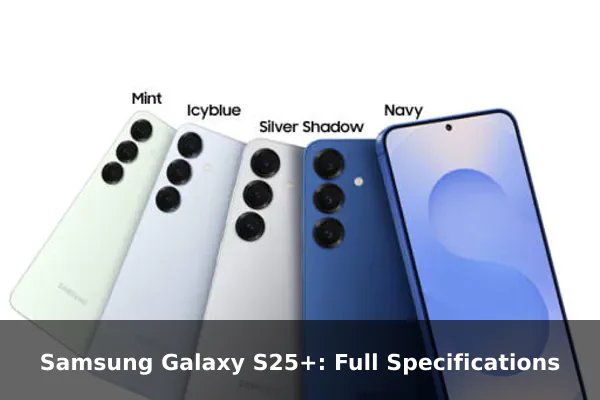
The Samsung Galaxy S25+ is the large-screen member of Samsung’s 2025 Galaxy S lineup, positioned for buyers who want flagship speed, a sharper display, and stronger endurance without moving into the Ultra model’s heavier camera-first profile.
Its spec sheet centers on a 6.7-inch QHD+ Dynamic LTPO AMOLED 2X display, Snapdragon 8 Elite power, 12GB of RAM, a 4900mAh battery, and a familiar triple rear camera system with 3x optical zoom.
Full Specifications
Network
| Technology: | GSM / CDMA / HSPA / EVDO / LTE / 5G |
| 2G bands: | GSM 850 / 900 / 1800 / 1900 |
| CDMA 800 / 1900 & TD-SCDMA | |
| 3G bands: | HSDPA 850 / 900 / 1700(AWS) / 1900 / 2100 |
| CDMA2000 1xEV-DO | |
| 4G bands: | 1, 2, 3, 4, 5, 7, 8, 12, 13, 17, 18, 19, 20, 25, 26, 28, 32, 38, 39, 40, 41, 66 – International |
| 1, 2, 3, 4, 5, 7, 8, 12, 13, 14, 18, 19, 20, 25, 26, 28, 29, 30, 38, 39, 40, 41, 48, 66, 71 – USA unlocked | |
| 5G bands: | 1, 2, 3, 5, 7, 8, 12, 20, 25, 26, 28, 38, 40, 41, 66, 75, 77, 78 SA/NSA/Sub6 – International |
| 1, 2, 5, 7, 25, 28, 41, 66, 71, 77, 78, 257, 258, 260, 261 SA/NSA/Sub6/mmWave – USA unlocked | |
| Speed: | HSPA, LTE (up to 7CA), 5G |
Launch
| Announced: | 2025, January 22 |
| Status: | Available. Released 2025, February 03 |
Body
| Dimensions: | 158.4 x 75.8 x 7.3 mm (6.24 x 2.98 x 0.29 in) |
| Weight: | 190 g (6.70 oz) |
| Build: | Glass front (Gorilla Glass Victus 2), glass back (Gorilla Glass Victus 2), aluminum frame |
| SIM: | Nano-SIM + Nano-SIM + eSIM + eSIM (max 2 at a time) – INT Nano-SIM + eSIM + eSIM (max 2 at a time) – USA Nano-SIM + Nano-SIM – CN |
| IP68 dust tight and water resistant (immersible up to 1.5m for 30 min) Armor aluminum 2 frame |
Display
| Type: | Dynamic LTPO AMOLED 2X, 120Hz, 480Hz PWM, HDR10+, 2600 nits (peak) |
| Size: | 6.7 inches, 110.2 cm2 (~91.8% screen-to-body ratio) |
| Resolution: | 1440 x 3120 pixels, 19.5:9 ratio (~513 ppi density) |
| Protection: | Corning Gorilla Glass Victus 2, Mohs level 5 |
Platform
| OS: | Android 15, up to 7 major Android upgrades, One UI 7 |
| Chipset: | Qualcomm SM8750-AC Snapdragon 8 Elite (3 nm) |
| CPU: | Octa-core (2×4.47 GHz Oryon V2 Phoenix L + 6×3.53 GHz Oryon V2 Phoenix M) |
| GPU: | Adreno 830 (1200 MHz) |
Memory
| Card slot: | No |
| Internal: | 256GB 12GB RAM, 512GB 12GB RAM |
| UFS 4.0 |
Main Camera
| Triple: | 50 MP, f/1.8, 24mm (wide), 1/1.56″, 1.0µm, dual pixel PDAF, OIS 10 MP, f/2.4, 67mm (telephoto), 1/3.94″, 1.0µm, PDAF, OIS, 3x optical zoom 12 MP, f/2.2, 13mm, 120˚ (ultrawide), 1/2.55″ 1.4µm, Super Steady video |
| Features: | Best Face, LED flash, auto-HDR, panorama |
| Video: | 8K@24/30fps, 4K@30/60fps, 1080p@30/60/120/240fps, 10-bit HDR, HDR10+, stereo sound rec., gyro-EIS |
Selfie camera
| Single: | 12 MP, f/2.2, 26mm (wide), 1/3.2″, 1.12µm, dual pixel PDAF |
| Features: | HDR, HDR10+ |
| Video: | 4K@30/60fps, 1080p@30fps |
Sound
| Loudspeaker: | Yes, with stereo speakers |
| 3.5mm jack: | No |
| 32-bit/384kHz audio Tuned by AKG |
Comms
| WLAN: | Wi-Fi 802.11 a/b/g/n/ac/6e/7, tri-band, Wi-Fi Direct |
| Bluetooth: | 5.4, A2DP, LE |
| Positioning: | GPS, GLONASS, BDS, GALILEO, QZSS |
| NFC: | Yes |
| Radio: | No |
| USB: | USB Type-C 3.2, DisplayPort 1.2, OTG |
Features
| Sensors: | Fingerprint (under display, ultrasonic), accelerometer, gyro, proximity, compass, barometer |
| Samsung DeX, Samsung Wireless DeX (desktop experience support) Ultra Wideband (UWB) support Circle to Search |
Battery
| Type: | Li-Ion 4900 mAh |
| Charging: | 45W wired, PD3.0, 65% in 30 min 15W wireless (Qi2 Ready) 4.5W reverse wireless |
Misc
| Colors: | Icy Blue, Mint, Navy, Silver Shadow, Pink Gold, Coral Red, Blue Black |
| Models: | SM-S936B, SM-S936B/DS, SM-S936U, SM-S936U1, SM-S936W, SM-S936N, SM-S9360, SM-S936E, SM-S936E/DS |
| SAR: | 1.16 W/kg (head) 0.81 W/kg (body) |
| SAR EU: | 1.26 W/kg (head) 1.26 W/kg (body) |
| Price: | € 750.00 / $ 600.00 / £ 790.00 / ₹ 104,999 |
Our Tests
| Performance: | AnTuTu: 2133477 (v10) GeekBench: 9669 (v6) 3DMark: 6601 (Wild Life Extreme) |
| Display: | 1449 nits max brightness (measured) |
| Loudspeaker: | -25.1 LUFS (Very good) |
| Battery: | Active use score 14:26h |
EU LABEL
| Energy: | Class B |
| Battery: | 43:38h endurance, 2000 cycles |
| Free fall: | Class A (270 falls) |
| Repairability: | Class C |
Price and Availability
The Samsung Galaxy S25+ offers a compelling combination of features and performance. While the base price is around €750, the actual cost may vary depending on your location and retailer. Below, you’ll find the approximate price of the Samsung Galaxy S25+ converted into various currencies. Please note that these are estimates based on recent exchange rates as of July 17, 2026 and may not reflect the exact price you’ll find at a retailer.
- United States: $859
- Japan: ¥139,392
- United Kingdom: £637
- Australia: A$1,227
- Canada: C$1,205
- Taiwan: NT$27,677
- Denmark: kr5.598
- Saudi Arabia: ﷼3,220
- South Korea: ₩1,272,012
- Germany: €750
- Brazil: R$4.374
- Vietnam: ₫22.486.540
- Kenya: KSh 111,100
- India: ₹82,729
- Indonesia: Rp 15.449.476
- Nigeria: ₦1,175,480
- Pakistan: ₨238,598
- Philippines: ₱52,946
- Bangladesh: ৳১,০৫,৮২৬
Value Position
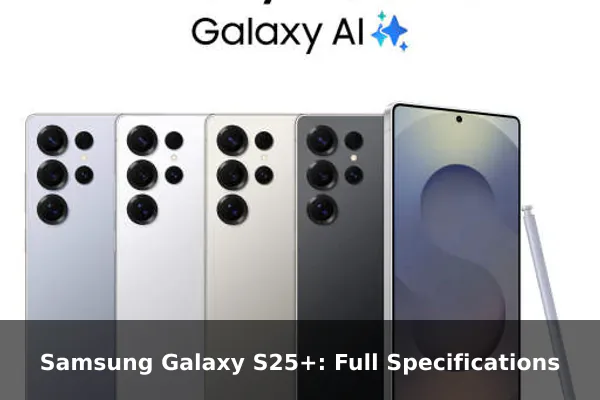
The Galaxy S25+ is best understood as Samsung’s balanced flagship: more screen and battery than a compact phone, but still slimmer and simpler than an all-out camera flagship. The raw price data lists several regional prices, but actual retail pricing can vary by market, storage tier, carrier plan, launch offers, and trade-in programs. For buyers comparing phones by hardware density, the strongest value points are the 1440 x 3120 display, 12GB RAM as standard, UFS 4.0 storage, Snapdragon 8 Elite chipset, and seven major Android upgrades.
The lack of a microSD slot means the 256GB and 512GB versions should be treated as long-term decisions. Heavy video shooters, offline media users, and mobile gamers should look at the 512GB option first, while cloud-first users will likely find 256GB adequate.
Design and Durability
At 158.4 x 75.8 x 7.3 mm and 190 g, the Galaxy S25+ keeps a notably slim profile for a phone with a 6.7-inch display and 4900mAh battery. The glass front and back use Gorilla Glass Victus 2, while the Armor Aluminum 2 frame adds a premium structural feel. The IP68 rating covers dust resistance and immersion in up to 1.5 meters of water for 30 minutes under tested conditions, which is useful protection but not a reason to treat the phone as waterproof in daily use.
SIM support depends on region. International versions support dual nano-SIM plus eSIM options with two active lines at a time, the USA configuration uses nano-SIM with eSIM support, and the China variant lists dual nano-SIM. That regional difference matters for travelers and business users who rely on multiple numbers.
Display Experience
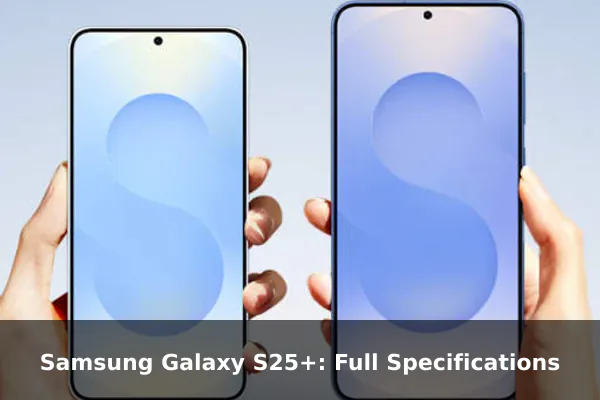
The 6.7-inch Dynamic LTPO AMOLED 2X panel is one of the phone’s most important upgrades over ordinary flagship displays. It combines a 120Hz refresh rate, HDR10+ support, 480Hz PWM, and a 2600-nit peak brightness claim. The QHD+ resolution gives the panel about 513 ppi, so text, maps, photos, and dense web pages should look exceptionally sharp.
Measured display brightness is listed at 1449 nits, which is still a very strong real-world figure for outdoor use. The approximately 91.8 percent screen-to-body ratio also helps the S25+ feel modern without making the chassis excessively large. Gorilla Glass Victus 2 protection with Mohs level 5 scratch resistance is a useful durability note, though a screen protector remains sensible for long-term ownership.
Performance Hardware
The Snapdragon 8 Elite for Galaxy-class hardware profile is the central performance story here. The Qualcomm SM8750-AC Snapdragon 8 Elite is built on a 3 nm process and uses an octa-core CPU layout with two 4.47GHz Oryon V2 Phoenix L cores and six 3.53GHz Oryon V2 Phoenix M cores. Graphics are handled by the Adreno 830 at 1200MHz.
Benchmark figures from the provided test data are high: AnTuTu v10 reaches 2,133,477, GeekBench v6 scores 9,669, and 3DMark Wild Life Extreme posts 6,601. Benchmarks do not describe every part of daily use, but they do show that the S25+ is built for demanding gaming, fast app switching, AI-assisted features, high-resolution video work, and long software support cycles.
Camera Setup
The rear camera system is a practical triple-camera arrangement rather than an experimental one. The main camera is a 50MP wide sensor with f/1.8 aperture, dual pixel PDAF, and optical image stabilization. It is joined by a 10MP telephoto camera with PDAF, OIS, and 3x optical zoom, plus a 12MP ultrawide camera with a 120-degree field of view and Super Steady video support.
Video support is broad, with 8K recording at 24 or 30fps, 4K at 30 or 60fps, and 1080p modes up to 240fps. The phone also lists 10-bit HDR, HDR10+, stereo sound recording, and gyro-EIS. The 12MP front camera includes dual pixel PDAF and supports 4K video at 30 or 60fps, making it suitable for sharp video calls, creator clips, and social video recording.
Battery and Charging
The 4900mAh battery gives the Galaxy S25+ a clear endurance focus. The provided active use score is 14 hours and 26 minutes, while the EU label lists 43 hours and 38 minutes of endurance and 2000 battery cycles. Those figures point to a phone designed for full-day use with room for heavier screen time, navigation, streaming, and camera use.
Charging is rated at 45W wired with PD3.0, with a listed 65 percent charge in 30 minutes. Wireless charging is rated at 15W and marked Qi2 Ready, while 4.5W reverse wireless charging is available for accessories. The charging setup is not the highest-wattage system in the Android market, but it is well rounded and standards-friendly.
Software and Long-Term Use
The Galaxy S25+ ships with Android 15 and One UI 7, with up to seven major Android upgrades. That support window is a major part of the phone’s long-term value because it extends the practical life of the device beyond raw launch-year performance. For buyers who keep phones for four years or more, this software promise may matter as much as the chipset.
Samsung DeX and Wireless DeX are also included, allowing the phone to work as a desktop-style device with compatible displays and accessories. Circle to Search adds another modern convenience layer, while the ultrasonic under-display fingerprint sensor keeps unlocking fast and familiar.
Connectivity and Extras
Connectivity is one of the S25+’s strongest specification areas. The phone supports broad GSM, CDMA, HSPA, EVDO, LTE, and 5G coverage, with separate international and USA unlocked band lists. The USA unlocked version also includes mmWave 5G bands, while the international model focuses on Sub6 5G. That makes the exact model number important before importing.
Wireless features include Wi-Fi 7, Wi-Fi 6E, tri-band Wi-Fi, Bluetooth 5.4, NFC, and multi-system positioning with GPS, GLONASS, BDS, GALILEO, and QZSS. USB Type-C 3.2 supports DisplayPort 1.2 and OTG. Ultra Wideband support is also present, which is useful for precise location features and compatible smart accessories.
Who Should Buy It?
The Galaxy S25+ is a strong fit for users who want a premium Samsung phone with a large, sharp display, top-tier Android performance, long software support, and dependable battery life. It makes particular sense for people who read, stream, game, multitask, travel often, or use DeX for light desktop-style work.
It is less ideal for buyers who need expandable storage, a 3.5mm headphone jack, FM radio, or the most advanced zoom-focused camera setup available in Samsung’s lineup. For most users who want a flagship that feels complete without becoming oversized or overly specialized, the S25+ is the more practical high-end choice.
Conclusion
The Samsung Galaxy S25+ combines a sharp 6.7-inch QHD+ AMOLED display, Snapdragon 8 Elite performance, long Android upgrade support, versatile cameras, and strong battery life in a slim premium body. It is easy to recommend for buyers who want a balanced Samsung flagship with more screen and endurance than a compact model, without paying mainly for specialist camera hardware.
References
- Samsung Mobile Press – Galaxy S25+ Tech Specs – Official Samsung press specifications for display, dimensions, cameras, memory/storage, battery, charging, OS, connectivity, and IP68 rating.
- Samsung US – Galaxy S25 and S25+ – Official Samsung product page with market-facing specifications, feature claims, storage options, battery figures, processor, camera, and durability details.
- Samsung Global Newsroom – Galaxy S25 Series Launch – Official launch announcement with spec tables and context for chipset, AI features, display, battery, camera, and availability notes.
- Qualcomm – Snapdragon 8 Elite Mobile Platform – Official chipset reference for the Snapdragon 8 Elite platform used in the Galaxy S25 series, useful for processor, GPU, modem, Wi-Fi, and AI engine details.
- Wireless Power Consortium – Galaxy S25+ Qi Certification – Official Qi certification record for Samsung Galaxy S25+ model SM-S936U, supporting wireless charging claims and certified power profile details.
