
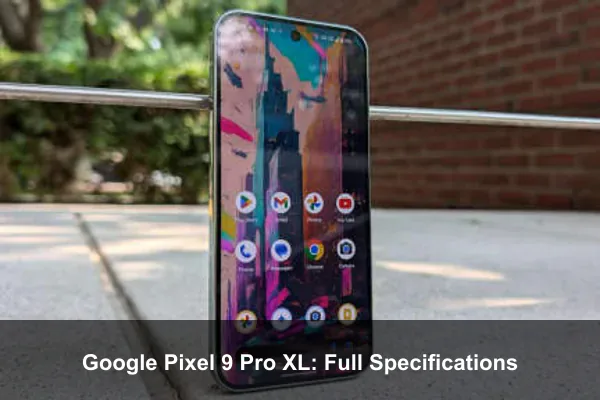
The Google Pixel 9 Pro XL is the company’s flagship statement for 2024, pairing a 6.8-inch LTPO OLED panel with the in-house Tensor G4 chip and a triple rear camera system built around computational photography. Announced on August 13, 2024 and released a little over a week later, it sits at the top of Google’s lineup with up to 1TB of storage, 16GB of RAM, and a polished aluminum-and-glass frame rated IP68.
What sets this model apart is Google’s blend of long software support, AI-driven imaging, and a battery that proves dependable in daily use. This article looks past the raw numbers to explain how the Pixel 9 Pro XL performs in real-world terms, where it earns its asking price, and which type of buyer will get the most from it.
Full Specifications
Network
| Technology: | GSM / HSPA / LTE / 5G |
| 2G bands: | GSM 850 / 900 / 1800 / 1900 |
| 3G bands: | HSDPA 800 / 850 / 900 / 1700(AWS) / 1900 / 2100 |
| 4G bands: | 1, 2, 3, 4, 5, 7, 8, 12, 13, 14, 17, 18, 19, 20, 25, 26, 28, 29, 30, 38, 40, 41, 48, 66, 71 – GGX8B |
| 1, 2, 3, 4, 5, 7, 8, 12, 13, 14, 17, 18, 19, 20, 21, 25, 26, 28, 29, 30, 32, 38, 39, 40, 41, 42, 48, 66, 71, 75 – GZC4K | |
| 5G bands: | 1, 2, 3, 5, 7, 8, 12, 14, 20, 25, 26, 28, 29, 30, 38, 40, 41, 48, 66, 70, 71, 77, 78, 258, 260, 261 SA/NSA/Sub6/mmWave – GGX8B |
| 1, 2, 3, 5, 7, 8, 12, 14, 20, 25, 26, 28, 30, 38, 40, 41, 66, 71, 75, 76, 77, 78, 79 SA/NSA/Sub6 – GZC4K | |
| Speed: | HSPA, LTE (CA), 5G |
Launch
| Announced: | 2024, August 13 |
| Status: | Available. Released 2024, August 22 |
Body
| Dimensions: | 162.8 x 76.6 x 8.5 mm (6.41 x 3.02 x 0.33 in) |
| Weight: | 221 g (7.80 oz) |
| Build: | Glass front (Gorilla Glass Victus 2), glass back (Gorilla Glass Victus 2), aluminum frame |
| SIM: | Nano-SIM + eSIM |
| IP68 dust tight and water resistant (immersible up to 1.5m for 30 min) |
Display
| Type: | LTPO OLED, 120Hz, HDR10+, 2000 nits (HBM), 3000 nits (peak) |
| Size: | 6.8 inches, 109.7 cm2 (~88.0% screen-to-body ratio) |
| Resolution: | 1344 x 2992 pixels, 20:9 ratio (~486 ppi density) |
| Protection: | Corning Gorilla Glass Victus 2, Mohs level 4 |
Platform
| OS: | Android 14, upgradable to Android 15, up to 7 major Android upgrades |
| Chipset: | Google Tensor G4 (4 nm) |
| CPU: | Octa-core (1×3.1 GHz Cortex-X4 & 3×2.6 GHz Cortex-A720 & 4×1.92 GHz Cortex-A520) |
| GPU: | Mali-G715 MC7 |
Memory
| Card slot: | No |
| Internal: | 128GB 16GB RAM, 256GB 16GB RAM, 512GB 16GB RAM, 1TB 16GB RAM |
| UFS 3.1 |
Main Camera
| Triple: | 50 MP, f/1.7, 25mm (wide), 1/1.31″, 1.2µm, dual pixel PDAF, OIS 48 MP, f/2.8, 113mm (periscope telephoto), 1/2.55″, dual pixel PDAF, OIS, 5x optical zoom 48 MP, f/1.7, 123˚ (ultrawide), 1/2.55″, dual pixel PDAF, |
| Features: | Multi-zone Laser AF, LED flash, Pixel Shift, Ultra-HDR, panorama, Best Take, Zoom Enhance |
| Video: | 8K@30fps (via cloud-based upscaling), 4K@24/30/60fps, 1080p@24/30/60/120/240fps; gyro-EIS, OIS, 10-bit HDR |
Selfie camera
| Single: | 42 MP, f/2.2, 17mm (ultrawide), PDAF |
| Features: | HDR, panorama |
| Video: | 4K@30/60fps, 1080p@30/60fps |
Sound
| Loudspeaker: | Yes, with stereo speakers |
| 3.5mm jack: | No |
Comms
| WLAN: | Wi-Fi 802.11 a/b/g/n/ac/6e/7, tri-band |
| Bluetooth: | 5.3, A2DP, LE, aptX HD |
| Positioning: | GPS (L1+L5), GLONASS, GALILEO, BDS, QZSS, NavIC |
| NFC: | Yes |
| Radio: | No |
| USB: | USB Type-C 3.2 |
Features
| Sensors: | Fingerprint (under display, ultrasonic), accelerometer, gyro, proximity, compass, barometer, thermometer (skin temperature) |
| Ultra Wideband (UWB) support Satellite SOS service Circle to Search |
Battery
| Type: | Li-Ion 5060 mAh |
| Charging: | 37W wired, PD3.0, PPS, 70% in 30 min 23W wireless (w/ Pixel Stand) 12W wireless (w/ Qi compatible charger) Reverse wireless Bypass charging |
Misc
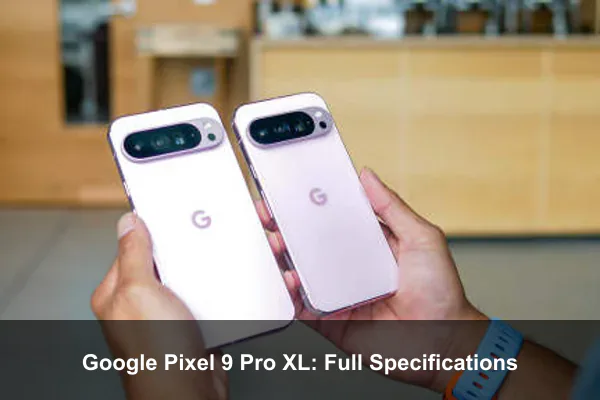
| Colors: | Porcelain, Rose Quartz, Hazel, Obsidian |
| Models: | GGX8B, GZC4K, GQ57S |
| SAR EU: | 0.99 W/kg (head) 1.40 W/kg (body) |
| Price: | € 726.00 / $ 599.00 / £ 569.99 / ₹ 110,999 |
Our Tests
| Performance: | AnTuTu: 1380138 (v10) GeekBench: 4854 (v6) 3DMark: 2540 (Wild Life Extreme) |
| Display: | 2365 nits max brightness (measured) |
| Loudspeaker: | -25.5 LUFS (Very good) |
| Battery: | Active use score 12:32h |
EU LABEL
| Energy: | Class B |
| Battery: | 49:30h endurance, 1000 cycles |
| Free fall: | Class A (270 falls) |
| Repairability: | Class C |
Price and Availability
The Google Pixel 9 Pro XL offers a compelling combination of features and performance. While the base price is around €726, the actual cost may vary depending on your location and retailer. Below, you’ll find the approximate price of the Google Pixel 9 Pro XL converted into various currencies. Please note that these are estimates based on recent exchange rates as of June 14, 2026 and may not reflect the exact price you’ll find at a retailer.
- United States: $840
- Japan: ¥134,570
- United Kingdom: £627
- Australia: A$1,193
- Canada: C$1,174
- Taiwan: NT$26,544
- Denmark: kr5.417
- Saudi Arabia: ﷼3,149
- South Korea: ₩1,276,987
- Germany: €726
- Brazil: R$4.282
- Vietnam: ₫21.920.602
- Kenya: KSh 108,734
- India: ₹79,959
- Indonesia: Rp 15.010.454
- Nigeria: ₦1,131,597
- Pakistan: ₨233,807
- Philippines: ₱51,062
- Bangladesh: ৳১,০৩,২৬৭
Is the Pixel 9 Pro XL Worth the Money?
Positioned as a true flagship, the Pixel 9 Pro XL competes directly with the largest Samsung Galaxy and Apple iPhone Pro Max models. Its value case rests less on headline silicon power and more on the complete package: a bright adaptive display, a versatile camera trio, IP68 durability, and an industry-leading promise of up to seven major Android upgrades. For buyers who keep a phone for years, that longevity meaningfully lowers the cost of ownership.
Design and Build Quality
At 162.8 x 76.6 x 8.5 mm and 221 g, this is a substantial device aimed at users who want a large canvas. The frosted glass back in Porcelain, Rose Quartz, Hazel, or Obsidian resists fingerprints, while Gorilla Glass Victus 2 on both faces and an aluminum frame give it a premium, reassuring feel. The IP68 rating allows immersion up to 1.5 meters for 30 minutes, and the EU label rates free-fall durability at Class A after 270 drops, signaling a phone engineered to survive everyday mishaps.
Display Experience
The 6.8-inch LTPO OLED runs at a smooth 120Hz with a sharp 1344 x 2992 resolution and roughly 486 ppi. Google quotes 2000 nits in high-brightness mode and 3000 nits peak, and independent testing measured around 2365 nits in practice, which keeps content readable under harsh sunlight. HDR10+ support, an 88% screen-to-body ratio, and Mohs level 4 scratch resistance round out one of the best panels in the class for both media and outdoor use.
Performance in Daily Use
The Tensor G4 is built on a 4 nm process with an octa-core layout led by a 3.1 GHz Cortex-X4 core and a Mali-G715 MC7 GPU. Benchmark figures, including an AnTuTu score near 1,380,138 and a GeekBench 6 result of 4854, place it behind the fastest Snapdragon rivals on paper. In daily use, however, the generous 16GB of RAM keeps multitasking fluid, and the chip’s real strength is on-device AI for photography, voice, and Circle to Search rather than raw gaming throughput.
Camera System and Imaging
The rear array combines a 50 MP wide with OIS, a 48 MP 5x periscope telephoto, and a 48 MP ultrawide, supported by multi-zone laser autofocus and features like Best Take, Zoom Enhance, and Ultra-HDR. Video tops out at 4K up to 60fps with 10-bit HDR, plus cloud-assisted 8K capture. A 42 MP ultrawide selfie camera handles 4K front video. Google’s computational pipeline remains the highlight, delivering consistent color and detail that often outshines hardware-heavier competitors.
Battery Life and Charging
A 5060 mAh Li-Ion cell delivers an Active Use Score of 12 hours and 32 minutes, with the EU label citing a 49:30h endurance rating across 1000 charge cycles. Charging is competent rather than class-leading at 37W wired, reaching about 70% in 30 minutes, alongside 23W wireless via Pixel Stand, 12W Qi, reverse wireless, and bypass charging for cooler gaming sessions.
Software and Longevity
Shipping with Android 14 and upgradable to Android 15, the Pixel 9 Pro XL guarantees up to seven major OS updates, the longest commitment in the Android world. Exclusive Pixel features such as Satellite SOS, Circle to Search, and a deep set of on-device AI tools arrive first here, making it a reference device for the latest Google software experiences.
Connectivity and Extras
Connectivity is comprehensive: Wi-Fi 7 tri-band, Bluetooth 5.3 with aptX HD, NFC, Ultra Wideband, and USB Type-C 3.2 for fast data transfer. Positioning covers dual-band GPS plus GLONASS, Galileo, BeiDou, QZSS, and NavIC. An ultrasonic under-display fingerprint sensor and a skin-temperature thermometer add to the sensor suite, while stereo speakers tested at a clean -25.5 LUFS.
Who Should Buy It
This phone suits photography enthusiasts, long-term owners who value extended updates, and anyone wanting a large, bright display with flagship durability. Mobile gamers chasing maximum frame rates may prefer a Snapdragon-powered rival, and those who want very fast charging should note the modest 37W wired ceiling.
Conclusion
The Google Pixel 9 Pro XL is a refined, software-first flagship that excels in imaging, display quality, and long-term support rather than raw benchmark dominance. If you prioritize camera consistency, seven years of updates, and a durable large-screen design, it is an easy recommendation; only heavy gamers or fast-charging seekers should weigh alternatives first.
