
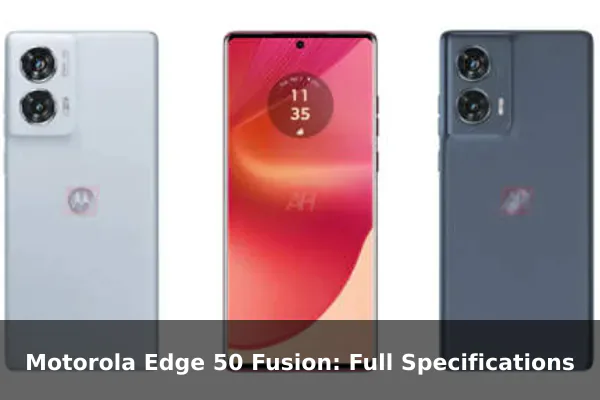
The Motorola Edge 50 Fusion is a mid-range Android phone built around a slim curved design, a large pOLED display, 5G connectivity, and fast wired charging. It sits below Motorola’s higher-end Edge models, but it still carries several premium touches that matter in daily use.
This specs-focused article looks at the Edge 50 Fusion from a value angle: what the hardware means, where the regional differences matter, and who should consider it before the full specification table is added separately.
Full Specifications
Network
| Technology: | GSM / HSPA / LTE / 5G |
| 2G bands: | GSM 850 / 900 / 1800 / 1900 |
| 3G bands: | HSDPA 850 / 900 / 1900 / 2100 |
| 4G bands: | 1, 2, 3, 5, 7, 8, 18, 19, 20, 26, 28, 32, 38, 40, 41, 42, 71 – International |
| 1, 2, 3, 5, 7, 8, 18, 19, 20, 26, 28, 32, 38, 40, 41, 42 – India | |
| 5G bands: | 1, 3, 5, 7, 8, 20, 26, 28, 38, 40, 41, 77, 78 SA/NSA |
| Speed: | HSPA, LTE, 5G |
Launch
| Announced: | 2024, April 16 |
| Status: | Available. Released 2024, May 15 |
Body
| Dimensions: | 161.9 x 73.1 x 7.9 mm (6.37 x 2.88 x 0.31 in) |
| Weight: | 174.9 g (6.17 oz) |
| Build: | Glass front, silicone polymer back (eco leather), plastic frame |
| SIM: | Nano-SIM + eSIMNano-SIM + Nano-SIM |
| IP68 dust tight and water resistant (immersible up to 1.5m for 30 min) |
Display
| Type: | P-OLED, 1B colors, 120Hz (LATAM), 144Hz (INT), 1600 nits (peak) |
| Size: | 6.7 inches, 108.4 cm2 (~91.6% screen-to-body ratio) |
| Resolution: | 1080 x 2400 pixels, 20:9 ratio (~393 ppi density) |
| Protection: | Corning Gorilla Glass 5 |
Platform
| OS: | Android 14, upgradable to Android 15, up to 3 major Android upgrades |
| Chipset: | Qualcomm SM7435-AB Snapdragon 7s Gen 2 (4 nm) – InternationalQualcomm SM6450 Snapdragon 6 Gen 1 (4 nm) – LATAM |
| CPU: | Octa-core (4×2.40 GHz Cortex-A78 & 4×1.95 GHz Cortex-A55) – InternationalOcta-core (4×2.2 GHz Cortex-A78 & 4×1.8 GHz Cortex-A55) – LATAM |
| GPU: | Adreno 710 |
Memory
| Card slot: | No |
| Internal: | 128GB 8GB RAM, 256GB 8GB RAM, 256GB 12GB RAM, 512GB 8GB RAM, 512GB 12GB RAM |
| UFS 2.2 |
Main Camera
| Dual: | 50 MP, f/1.9, (wide), 1/1.56″, 1.0µm, multi-directional PDAF, OIS 13 MP, f/2.2, 120˚ (ultrawide), 1/3.0″, 1.12µm, AF |
| Features: | LED flash, HDR, panorama |
| Video: | 4K@30fps, 1080p@30/60/120fps, gyro-EIS |
Selfie camera
| Single: | 32 MP, f/2.5, (wide), 1/3.14″, 0.7µm |
| Features: | HDR |
| Video: | 4K@30fps, 1080p@30fps |
Sound
| Loudspeaker: | Yes, with stereo speakers |
| 3.5mm jack: | No |
Comms
| WLAN: | Wi-Fi 802.11 a/b/g/n/ac, dual-band |
| Bluetooth: | 5.2, A2DP, LE |
| Positioning: | GPS, GLONASS, GALILEO |
| NFC: | Yes |
| Radio: | No |
| USB: | USB Type-C 2.0, OTG |
Features
| Sensors: | Fingerprint (under display, optical), accelerometer, gyro, proximity, compass |
| Smart Connect (Ready For) support |
Battery
| Type: | 5000 mAh |
| Charging: | 68W wired, 50% in 15 min |
Misc
| Colors: | Forest Blue, Marshmallow Blue, Hot Pink |
| Models: | XT2429-1 |
| Price: | € 234.62 / $ 225.00 / £ 278.84 / ₹ 18,466 |
Our Tests
| Performance: | AnTuTu: 520319 (v9), 580458 (v10)
GeekBench: 2885 (v5), 2938 (v6) |
| Display: | 1322 nits max brightness (measured) |
| Loudspeaker: | -24.2 LUFS (Very good) |
| Battery: | Active use score 12:40h |
Price and Availability
The Motorola Edge 50 Fusion offers a compelling combination of features and performance. While the base price is around €235, the actual cost may vary depending on your location and retailer. Below, you’ll find the approximate price of the Motorola Edge 50 Fusion converted into various currencies. Please note that these are estimates based on recent exchange rates as of September 1, 2026 and may not reflect the exact price you’ll find at a retailer.
- United States: $272
- Japan: ¥43,522
- United Kingdom: £201
- Australia: A$380
- Canada: C$378
- Taiwan: NT$8,633
- Denmark: kr1.754
- Saudi Arabia: ﷼1,021
- South Korea: ₩372,687
- Germany: €235
- Brazil: R$1.411
- Vietnam: ₫7.056.487
- Kenya: KSh 35,222
- India: ₹25,914
- Indonesia: Rp 4.827.738
- Nigeria: ₦367,958
- Pakistan: ₨75,642
- Philippines: ₱16,978
- Bangladesh: ৳৩৩,৫৩৪
Value Positioning
The Motorola Edge 50 Fusion is best understood as a style-forward mid-range phone rather than a stripped-down budget model. Its appeal comes from combining a 6.7-inch curved pOLED screen, IP68 protection, stereo speakers, a 5000 mAh battery, and 68W wired charging in a body that remains under 8 mm thick. That mix makes it competitive for buyers who want a polished everyday phone without moving into flagship pricing.
The raw price data places it in a highly contested segment, so the important question is not whether it has every possible feature, but whether the compromises are sensible. The lack of a microSD card slot and 3.5 mm headphone jack may matter to some users, but the available internal storage tiers, UFS 2.2 storage, NFC, eSIM support on some versions, and strong charging specification help balance the package.
Design and Durability
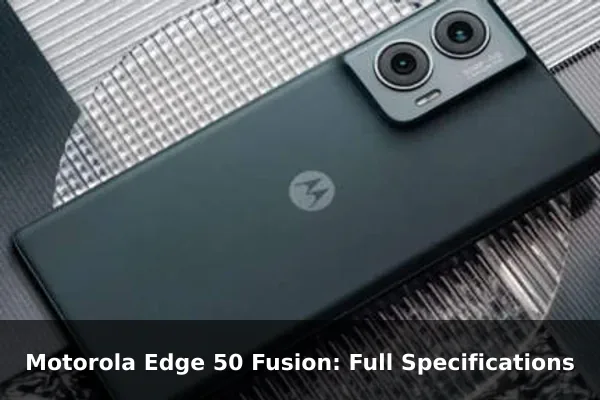
Motorola gives the Edge 50 Fusion a slim body measuring 161.9 x 73.1 x 7.9 mm and a weight of 174.9 g, which is relatively light for a phone with a 6.7-inch display and 5000 mAh battery. The build uses a glass front, a plastic frame, and a silicone polymer rear finish described as eco leather on listed variants. The result is more about comfort and grip than cold-metal luxury.
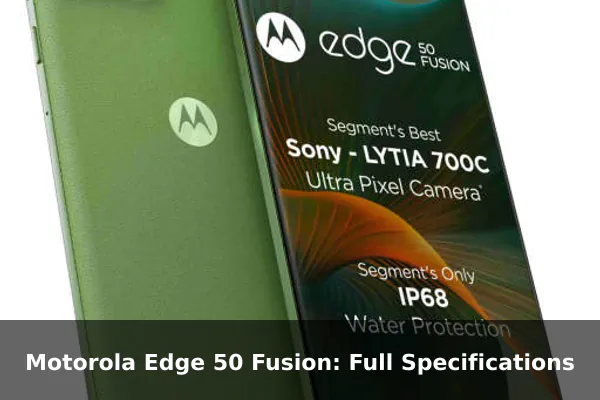
The standout durability feature is IP68 dust and water resistance, rated for immersion up to 1.5 meters for 30 minutes. That is not a reason to treat the phone casually around water, but it is a valuable safeguard in a mid-range device. Gorilla Glass 5 protection on the display also helps with everyday scratch and impact resistance, though a case and screen protector still make sense for long-term use.
Display Experience
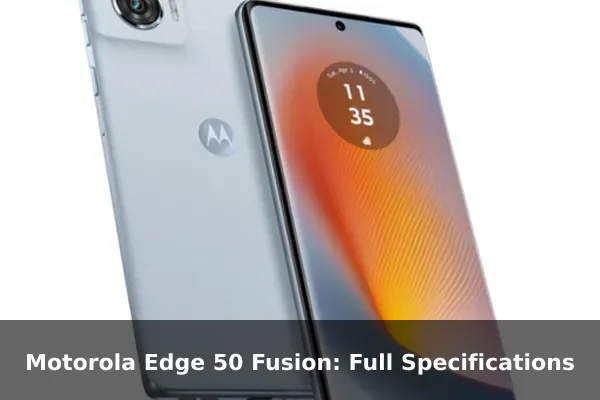
The display is one of the Edge 50 Fusion’s strongest areas. The 6.7-inch pOLED panel supports 1 billion colors, a 1080 x 2400 resolution, and a tall 20:9 aspect ratio, giving it enough sharpness for streaming, reading, social media, and gaming. The listed screen-to-body ratio is very high, so the phone should feel visually immersive despite not being a flagship.
Refresh rate depends on region, with LATAM versions listed at 120Hz and international versions at 144Hz. Both are smooth enough for daily navigation, but buyers comparing variants should be aware of the difference. Peak brightness is listed at 1600 nits, while the measured test result of 1322 nits suggests strong outdoor readability for the class.
Performance and Regional Chipsets
The most important performance detail is that the Edge 50 Fusion does not use the same chipset everywhere. International models are listed with the Snapdragon 7s Gen 2, while LATAM models use the Snapdragon 6 Gen 1. Both are 4 nm Qualcomm platforms with octa-core CPU layouts, but the international variant has the stronger positioning on paper.
For normal use, the phone should handle messaging, web browsing, video streaming, maps, banking apps, and multitasking without trouble, especially with 8GB or 12GB of RAM. The supplied benchmark results, including AnTuTu scores above 520,000 and a Wild Life Extreme score of 793, point to competent mid-range performance rather than high-end gaming power. Demanding games should run, but sustained graphics settings will need realistic expectations.
Storage and Memory Choices
Motorola lists several memory configurations: 128GB with 8GB RAM, 256GB with 8GB RAM, 256GB with 12GB RAM, 512GB with 8GB RAM, and 512GB with 12GB RAM. Since there is no card slot, choosing the right storage version at purchase matters more than it would on a phone with expandable storage.
The 256GB version is likely the most balanced choice for many users, especially if they record 4K video or keep large offline media libraries. The 512GB models are better for heavy camera users and people who keep their phones for several years. UFS 2.2 is not cutting-edge, but it is appropriate for this price class and should feel responsive in routine app launches and file handling.
Camera Hardware
The rear camera system keeps the setup focused: a 50 MP wide camera with optical image stabilization and a 13 MP ultrawide camera with autofocus. This is more useful than adding low-resolution filler sensors, because the ultrawide can handle wider scenes and may also help with close-up flexibility depending on the camera software.
Video support reaches 4K at 30fps on both the rear and front cameras, which is a useful advantage for creators who want sharper clips from either side. The rear camera also supports 1080p recording at higher frame rates and gyro-EIS. The 32 MP front camera should be more than adequate for selfies and video calls, though low-light results will depend heavily on processing and stabilization.
Battery and Charging
A 5000 mAh battery gives the Edge 50 Fusion a solid foundation for daily endurance. The supplied active use score of 12 hours and 40 minutes suggests it can handle a full mixed-use day for many buyers, with room for streaming, navigation, messaging, and camera use.
The 68W wired charging is one of the phone’s clearest practical advantages. The listed claim of 50 percent in 15 minutes means short charging sessions can be genuinely useful. There is no wireless charging in the provided specification data, so buyers who use charging pads should factor that into the decision.
Software and Everyday Features
The phone ships with Android 14 and is listed as upgradable to Android 15, with up to three major Android upgrades. That gives the Edge 50 Fusion a better long-term software outlook than many older mid-range models, although update timing can vary by market and carrier.
Security and convenience features include an under-display optical fingerprint reader, accelerometer, gyroscope, proximity sensor, and compass. Smart Connect, also known as Ready For support, adds value for users who want Motorola’s device-to-screen and productivity features. It is a useful extra in a phone that is otherwise priced and positioned for mainstream buyers.
Connectivity and Audio
The Edge 50 Fusion supports GSM, HSPA, LTE, and 5G, with wide band coverage listed for international and India variants. The 5G support includes SA and NSA bands, making it suitable for modern carrier networks where supported. As always, buyers should compare the exact regional model with their carrier’s bands before importing.
Wireless connectivity includes dual-band Wi-Fi ac, Bluetooth 5.2, GPS, GLONASS, GALILEO, NFC, and USB Type-C 2.0 with OTG. Stereo speakers are included, and the measured loudspeaker result is rated very good. The missing 3.5 mm jack is the main audio limitation, so wired headphone users will need USB-C audio or Bluetooth.
Who Should Buy It?
The Motorola Edge 50 Fusion is a good match for buyers who prioritize design, display quality, water resistance, battery life, and fast charging over flagship camera zoom or top-tier gaming performance. It also makes sense for users who want a clean Android experience with useful Motorola extras and enough storage options for longer ownership.
It is less ideal for people who need expandable storage, a headphone jack, wireless charging, or the fastest possible chipset in the price range. Buyers should also pay attention to regional chipset and refresh-rate differences, because the international and LATAM versions are not identical.
Conclusion
The Motorola Edge 50 Fusion delivers a strong mid-range balance with a premium-feeling curved pOLED display, IP68 protection, capable cameras, 5G, long battery life, and very fast wired charging. Its main trade-offs are the missing microSD slot, no 3.5 mm jack, and regional hardware differences. For buyers who want a stylish Android phone with practical strengths rather than raw flagship power, it is an easy model to shortlist.
References
- Motorola official product page – motorola edge 50 fusion – Primary manufacturer page for the device, useful for headline specs, design, display, camera, battery, charging, materials, and feature claims.
- Motorola Support – Specifications: motorola edge 50 fusion – Official Motorola support specification sheet with structured details such as processor, RAM, storage, display, dimensions, battery, camera, connectivity, SIM, and network bands.
- Motorola News – Edge 50 series official announcement – Official launch announcement for the Edge 50 family, useful for release context, positioning, camera claims, colors, IP rating, and market availability notes.
- Qualcomm – Snapdragon 7s Gen 2 Mobile Platform – Official chipset reference for verifying processor-related claims, CPU/GPU platform details, connectivity support, and process/spec capabilities.
- GSMArena – Motorola Edge 50 Fusion specifications – Established phone specifications database suitable as a secondary cross-check against Motorola's official specs, especially for launch status, dimensions, network bands, and variant differences.
