
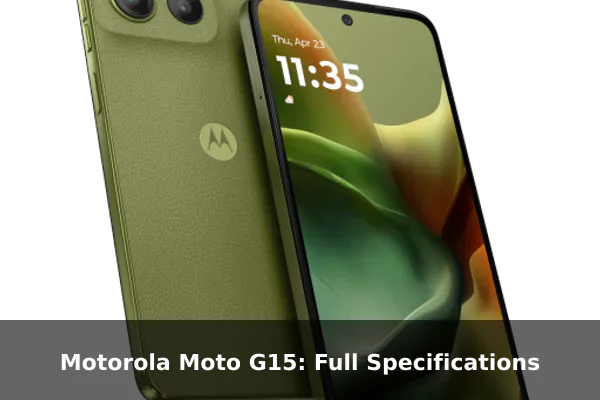
The Motorola Moto G15 is a budget Android phone built around practical basics rather than headline-chasing extras. It pairs a large 6.72-inch Full HD+ display with a 5200 mAh battery, Android 15, stereo speakers, expandable storage, and a 3.5 mm headphone jack.
Its biggest story is value: this is a 4G Motorola phone aimed at buyers who want a modern screen, long battery life, simple dual-SIM flexibility, and everyday reliability without paying for 5G or premium materials.
Full Specifications
Network
| Technology: | GSM / HSPA / LTE |
| 2G bands: | GSM 850 / 900 / 1800 / 1900 |
| 3G bands: | HSDPA 850 / 900 / 1900 / 2100 |
| 4G bands: | 1, 2, 3, 5, 7, 8, 20, 28, 38, 40, 41 |
| Speed: | HSPA, LTE |
Launch
| Announced: | 2024, December 17 |
| Status: | Available. Released 2025, February 12 |
Body
| Dimensions: | 165.7 x 76 x 8.2 mm (6.52 x 2.99 x 0.32 in) |
| Weight: | 190 g (6.70 oz) |
| Build: | Glass front (Gorilla Glass 3), plastic frame, silicone polymer back (eco leather) |
| SIM: | Nano-SIM + Nano-SIM |
| IP54 dust protected and water resistant (water splashes) |
Display
| Type: | IPS LCD |
| Size: | 6.72 inches, 109.0 cm2 (~86.6% screen-to-body ratio) |
| Resolution: | 1080 x 2400 pixels, 20:9 ratio (~392 ppi density) |
| Protection: | Corning Gorilla Glass 3, Mohs level 4 |
Platform
| OS: | Android 15 |
| Chipset: | Mediatek Helio G81 Extreme (12 nm) |
| CPU: | Octa-core (2×2.0 GHz Cortex-A75 & 6×1.7 GHz Cortex-A55) |
| GPU: | Mali-G52 MC2 |
Memory
| Card slot: | microSDXC |
| Internal: | 128GB 4GB RAM, 256GB 4GB RAM, 256GB 6GB RAM, 256GB 8GB RAM, 512GB 4GB RAM, 512GB 8GB RAM |
Main Camera
| Dual: | 50 MP, f/1.8, (wide), PDAF 5 MP, f/2.4, (ultrawide) |
| Features: | LED flash, HDR, panorama |
| Video: | 1080p@30fps |
Selfie camera
| Single: | 8 MP, f/2.0, (wide), 1.12µm |
| Video: | 1080p@30fps |
Sound
| Loudspeaker: | Yes, with stereo speakers |
| 3.5mm jack: | Yes |
Comms
| WLAN: | Wi-Fi 802.11 a/b/g/n/ac, dual-band |
| Bluetooth: | 5.0, A2DP, LE |
| Positioning: | GPS, GALILEO, GLONASS, BDS, QZSS |
| NFC: | Yes (market/region dependent) |
| Radio: | FM radio |
| USB: | USB Type-C 2.0 |
Features
| Sensors: | Fingerprint (side-mounted), accelerometer, gyro, proximity, compass |
Battery
| Type: | 5200 mAh |
| Charging: | 18W wired |
Misc
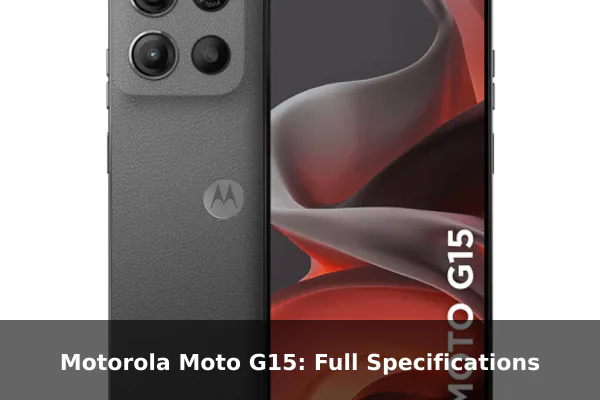
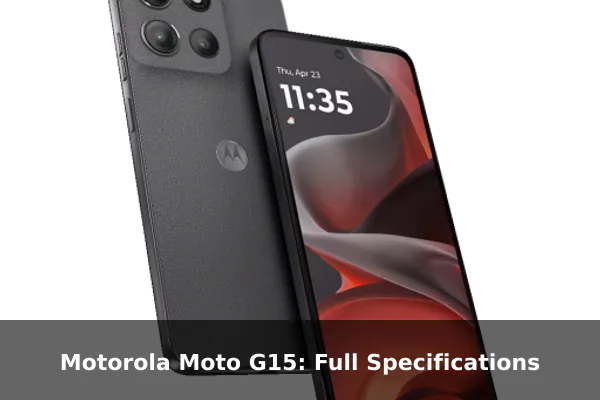
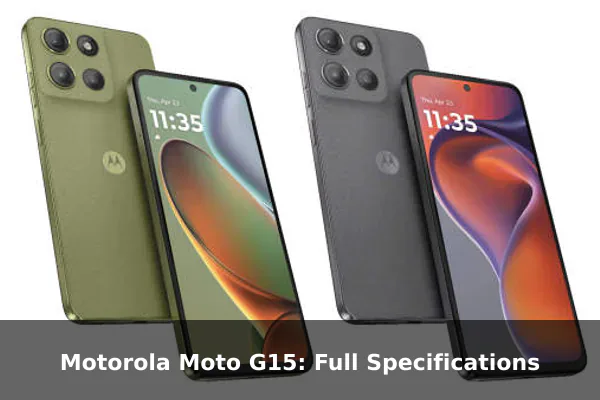
| Colors: | Gravity Grey, Iguana Green, Sunrise Orange, Sea Blue, Glacier Blue |
| Models: | XT2521-3 |
| Price: | € 99.00 / £ 99.99 |
EU LABEL
| Energy: | Class A |
| Battery: | 57:13h endurance, 1000 cycles |
| Free fall: | Class B (180 falls) |
| Repairability: | Class B |
Price and Availability
The Motorola Moto G15 offers a compelling combination of features and performance. While the base price is around €99, the actual cost may vary depending on your location and retailer. Below, you’ll find the approximate price of the Motorola Moto G15 converted into various currencies. Please note that these are estimates based on recent exchange rates as of August 23, 2026 and may not reflect the exact price you’ll find at a retailer.
- United States: $116
- Japan: ¥18,376
- United Kingdom: £85
- Australia: A$162
- Canada: C$159
- Taiwan: NT$3,683
- Denmark: kr740
- Saudi Arabia: ﷼434
- South Korea: ₩160,437
- Germany: €99
- Brazil: R$601
- Vietnam: ₫3.021.368
- Kenya: KSh 14,976
- India: ₹11,078
- Indonesia: Rp 2.046.390
- Nigeria: ₦157,065
- Pakistan: ₨32,095
- Philippines: ₱7,142
- Bangladesh: ৳১৪,১২৯
Value Position
The Moto G15 sits in the low-cost Android segment, but its specification mix is more useful than the price point might suggest. The phone focuses on features people notice every day: a sharp 1080p display, a large battery, stereo speakers, a side fingerprint reader, NFC on supported regional variants, FM radio, USB-C, and microSDXC expansion. That combination makes it a practical option for students, backup-phone buyers, first-time smartphone users, and anyone who wants a straightforward handset for messaging, maps, streaming, banking, and casual photography.
The main compromise is clear: this is not a 5G phone. Motorola uses GSM, HSPA, and LTE connectivity, so buyers who specifically want next-generation network support should look elsewhere. For users in areas where 4G LTE remains strong and affordable, however, the Moto G15 makes sense because it spends its budget on screen size, battery capacity, and day-to-day usability instead of chasing faster network branding.
Design and Build
Motorola gives the Moto G15 a practical body measuring 165.7 x 76 x 8.2 mm and weighing 190 g. That makes it a large phone, but not unusually heavy for a model with a 6.72-inch screen and a 5200 mAh battery. The build combines a Gorilla Glass 3 front, a plastic frame, and a silicone polymer back with an eco-leather style finish. This should give the phone a softer hand feel than glossy plastic, while still keeping the construction cost under control.
The IP54 rating is another useful detail at this price. It means the phone is dust protected and resistant to water splashes, but it should not be treated as waterproof. The dual Nano-SIM layout is useful for separating personal and work numbers or mixing mobile plans while traveling. Color choices are also broader than expected, with Gravity Grey, Iguana Green, Sunrise Orange, Sea Blue, and Glacier Blue giving the device a more personal look than a basic black-only budget model.
Display Experience
The 6.72-inch IPS LCD is one of the Moto G15’s strongest specification points. Its 1080 x 2400 pixel resolution gives it a crisp density of about 392 ppi, which is sharper than the lower-resolution panels still found on many budget phones. The 20:9 aspect ratio also suits scrolling feeds, messaging apps, web pages, and streaming video, while the listed screen-to-body ratio of around 86.6 percent helps the phone feel modern from the front.
This is an LCD panel rather than OLED, so buyers should not expect the same deep blacks or contrast as more expensive phones. Still, for reading, video calls, navigation, social media, and YouTube, the Full HD+ resolution is more important than panel prestige. Corning Gorilla Glass 3 with a listed Mohs level 4 protection adds a reasonable layer of scratch resistance, though a case and screen protector are still sensible for daily use.
Performance and Everyday Speed
The Moto G15 runs on the MediaTek Helio G81 Extreme, a 12 nm chipset with an octa-core CPU made up of two Cortex-A75 cores at 2.0 GHz and six Cortex-A55 cores at 1.7 GHz. Graphics are handled by the Mali-G52 MC2. This hardware is aimed at everyday Android use rather than demanding gaming, so expectations should be realistic: messaging, browsing, maps, video playback, online classes, lightweight editing, and casual games are the natural fit.
The memory options are unusually broad. The phone is listed with 128GB or 256GB storage paired with 4GB RAM, 256GB with 6GB or 8GB RAM, and 512GB variants with 4GB or 8GB RAM. The best long-term choices are the 6GB and 8GB RAM versions because Android apps continue to grow heavier over time. The microSDXC slot is also important, especially for buyers who store offline music, downloaded videos, photos, or large chat backups.
Camera Setup
The rear camera system is simple but useful. The main camera is a 50 MP wide sensor with an f/1.8 aperture and PDAF, paired with a 5 MP f/2.4 ultrawide camera. This is a better pairing than a main camera plus low-value macro or depth sensor because the ultrawide lens actually gives a different field of view for landscapes, rooms, group photos, and travel scenes.
Video recording tops out at 1080p at 30 fps on both the rear and front cameras. The 8 MP selfie camera has an f/2.0 aperture and 1.12 micrometer pixels. It should be fine for video calls, simple portraits, and social posts in good lighting, but this is not a creator-focused camera phone. The LED flash, HDR, and panorama modes round out the basics without pretending to compete with mid-range or flagship imaging systems.
Battery and Charging
The 5200 mAh battery is a major advantage for the Moto G15. Combined with a modest 4G chipset and an LCD display, it should be well suited to long daily use. The EU label data lists 57:13h endurance, 1000 battery cycles, Class A energy rating, Class B free-fall performance for 180 falls, and Class B repairability. Those labels make the phone easier to compare for durability and ownership cost, especially for buyers who keep phones for several years.
Charging is more modest at 18W wired. That is acceptable for an entry-level device, but it will not feel especially fast beside phones with 33W, 45W, or higher charging. The practical approach is to charge overnight or top up during idle periods. For many buyers, the larger battery matters more than the charging speed because it reduces the need to hunt for a charger during the day.
Software and Features
Shipping with Android 15 gives the Moto G15 a modern software foundation out of the box. The phone also includes a useful sensor set: a side-mounted fingerprint reader, accelerometer, gyro, proximity sensor, and compass. The side fingerprint reader is a sensible choice for a budget LCD phone because it is quick, reliable, and avoids the cost and variability of lower-end in-display solutions.
Motorola’s official help and support materials are useful references for setup, SIM and microSD handling, gestures, and device behavior. For buyers who prefer phones that are easy to understand, the Moto G15’s feature list is reassuringly conventional: no folding screen, no stylus dependency, no gaming triggers, and no experimental hardware. It is simply a large-screen Android phone with the familiar tools most people still use.
Connectivity and Audio
Connectivity covers Wi-Fi 802.11 a/b/g/n/ac dual-band, Bluetooth 5.0 with A2DP and LE, GPS, GALILEO, GLONASS, BDS, and QZSS positioning. LTE band support includes bands 1, 2, 3, 5, 7, 8, 20, 28, 38, 40, and 41, which gives the phone broad 4G coverage for many markets, though buyers should still check carrier compatibility before purchase. NFC is listed as market or region dependent, so contactless payment support may vary by model and country.
Audio is a pleasant strength. The Moto G15 includes stereo speakers and a 3.5 mm headphone jack, two features that are not guaranteed even on more expensive phones. FM radio support is another useful inclusion for markets where offline radio remains important. The USB Type-C 2.0 port handles charging and wired data, while the lack of 5G remains the main connectivity limitation.
Who Should Buy It?
The Motorola Moto G15 is best for buyers who want a low-cost Android phone with a big sharp screen, strong battery capacity, expandable storage, dual-SIM support, and traditional audio features. It is especially appealing if 4G coverage is already good in your area and you care more about battery life and storage flexibility than benchmark scores or premium materials.
It is less suitable for users who need 5G, fast charging, high-end gaming performance, OLED contrast, 4K video recording, or advanced camera processing. In comparison-friendly terms, the Moto G15 is not trying to beat mid-range phones at their own game. Its appeal is simpler: it gives budget buyers a balanced Motorola package with Android 15, a Full HD+ display, and a battery-first personality.
Conclusion
The Motorola Moto G15 is a sensible budget 4G smartphone with a large Full HD+ display, 5200 mAh battery, expandable storage, stereo speakers, and Android 15. Choose it if you want dependable everyday features at a low price; skip it if 5G, fast charging, or advanced cameras are essential.
References
- Motorola official Moto G15 product page – Primary manufacturer page with official Moto G15 specifications, feature claims, design details, battery, display, camera, storage, and connectivity information.
- Motorola Support – Specifications: moto g15 – Official support specification sheet suitable for anchoring exact technical specs such as dimensions, weight, bands, processor, battery, display, cameras, sensors, and ports.
- Motorola Help – moto g15 user guide – Official device help and user guide for hardware, setup, SIM/microSD handling, gestures, and software behavior.
- Motorola Support – Declarations of Conformity – Official regulatory page listing Moto G15 model identifiers such as XT2521-3 and MC438, useful for confirming model naming and compliance references.
- MediaTek Helio G81 product page – Official chipset vendor reference for the Helio G81 platform family, CPU/GPU details, connectivity capabilities, memory support, and media features.
