
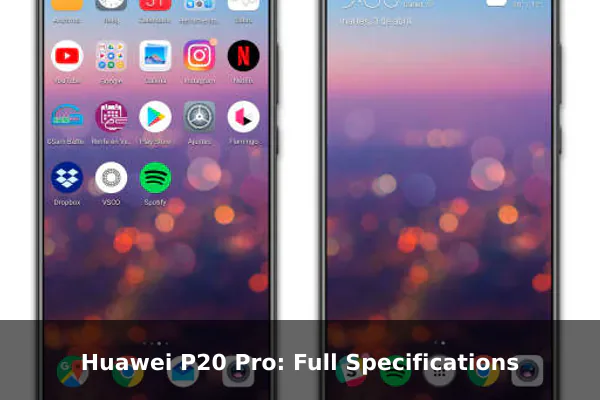
The Huawei P20 Pro remains one of Huawei’s most recognizable camera-focused flagships, built around a Leica-branded triple rear camera system, a 6.1-inch OLED display, and the Kirin 970 platform. Announced on March 27, 2018 and released on April 6, 2018, it now sits as a discontinued model, but its hardware still makes it an important reference point for premium Android phone design.
This article looks at the Huawei P20 Pro from a specs-first perspective, focusing on what its display, performance, camera system, battery, software, and connectivity mean for buyers comparing older flagship phones today. A separate full specifications table will provide the raw technical listing.
Full Specifications
Network
| Technology: | GSM / HSPA / LTE |
| 2G bands: | GSM 850 / 900 / 1800 / 1900 |
| 3G bands: | HSDPA 850 / 900 / 1900 / 2100 |
| 4G bands: | 1, 2, 3, 4, 5, 6, 7, 8, 9, 12, 17, 18, 19, 20, 26, 28, 32, 34, 38, 39, 40 |
| Speed: | HSPA 42.2/5.76 Mbps, LTE (3CA) Cat16 1024/150 Mbps |
Launch
| Announced: | 2018, March 27. Released 2018, April 06 |
| Status: | Discontinued |
Body
| Dimensions: | 155 x 73.9 x 7.8 mm (6.10 x 2.91 x 0.31 in) |
| Weight: | 180 g (6.35 oz) |
| Build: | Glass front (Gorilla Glass 5), glass back, aluminum frame |
| SIM: | Nano-SIMNano-SIM + Nano-SIM |
| IP67 dust/water resistant (up to 1m for 30 min) |
Display
| Type: | OLED |
| Size: | 6.1 inches, 93.9 cm2 (~82.0% screen-to-body ratio) |
| Resolution: | 1080 x 2240 pixels, 18.7:9 ratio (~408 ppi density) |
| Protection: | Corning Gorilla Glass 5 |
Platform
| OS: | Android 8.1 (Oreo), upgradable to Android 10, EMUI 12 |
| Chipset: | Kirin 970 (10 nm) |
| CPU: | Octa-core (4×2.4 GHz Cortex-A73 & 4×1.8 GHz Cortex-A53) |
| GPU: | Mali-G72 MP12 |
Memory
| Card slot: | No |
| Internal: | 64GB 6GB RAM, 128GB 6GB RAM, 128GB 8GB RAM, 256GB 6GB RAM, 256GB 8GB RAM |
| UFS 2.1 |
Main Camera
| Triple: | 40 MP, f/1.8, 27mm (wide), 1/1.7″, PDAF, OIS 8 MP, f/2.4, 80mm (telephoto), 1/4.0″, PDAF, OIS, 3x optical zoom 20 MP B/W, f/1.6, 27mm (wide), 1/2.7″ |
| Features: | Laser AF, color spectrum sensor, Leica optics, LED flash, HDR, panorama |
| Video: | 4K@30fps, 1080p@60fps, 1080p@30fps (gyro-EIS), 720p@960fps |
Selfie camera
| Single: | 24 MP, f/2.0, 26mm (wide), 1/2.8″, 0.9µm |
| Features: | Leica optics |
| Video: | 1080p@30fps |
Sound
| Loudspeaker: | Yes, with stereo speakers |
| 3.5mm jack: | No |
| 32-bit/384kHz audio |
Comms
| WLAN: | Wi-Fi 802.11 a/b/g/n/ac, dual-band, Wi-Fi Direct |
| Bluetooth: | 4.2, A2DP, LE, EDR, aptX HD |
| Positioning: | GPS, GLONASS, GALILEO |
| NFC: | Yes |
| Infrared port: | Yes |
| Radio: | No |
| USB: | USB Type-C 3.1 |
Features
| Sensors: | Fingerprint (front-mounted), accelerometer, gyro, proximity, compass |
Battery
| Type: | Li-Po 4000 mAh, non-removable |
| Charging: | 22.5W wired, 58% in 30 min |
Misc
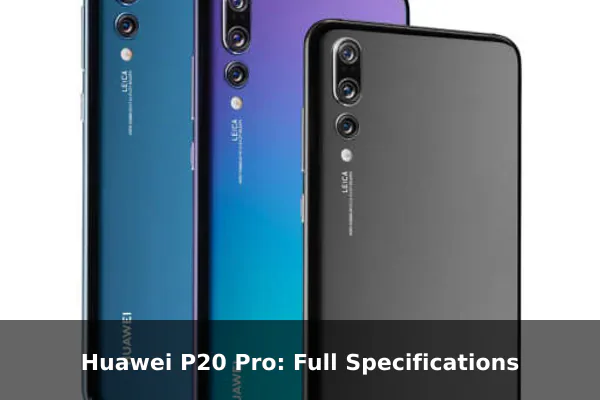
| Colors: | Black, Gold |
| Models: | CLT-L29C, CLT-L29, CLT-L09C, CLT-L09, CLT-AL00, CLT-AL01, CLT-TL01, CLT-AL00L, CLT-L04, HW-01K, CLT-L0J |
| Price: | About 410 EUR |
Our Tests
| Performance: | AnTuTu: 209884 (v7) GeekBench: 6679 (v4.4) GFXBench: 21fps (ES 3.1 onscreen) |
| Display: | Contrast ratio: Infinite (nominal), 4.087 (sunlight) |
| Camera: | Photo / Video |
| Loudspeaker: | Voice 71dB / Noise 69dB / Ring 91dB |
| Audio quality: | Noise -92.1dB / Crosstalk -92.1dB |
| Battery (old): | Endurance rating 89h |
Price and Availability
The Huawei P20 Pro offers a compelling combination of features and performance. While the base price is around €410, the actual cost may vary depending on your location and retailer. Below, you’ll find the approximate price of the Huawei P20 Pro converted into various currencies. Please note that these are estimates based on recent exchange rates as of August 5, 2026 and may not reflect the exact price you’ll find at a retailer.
- United States: $473
- Japan: ¥74,476
- United Kingdom: £351
- Australia: A$672
- Canada: C$664
- Taiwan: NT$15,305
- Denmark: kr3.060
- Saudi Arabia: ﷼1,772
- South Korea: ₩674,527
- Germany: €410
- Brazil: R$2.406
- Vietnam: ₫12.330.669
- Kenya: KSh 61,114
- India: ₹45,049
- Indonesia: Rp 8.508.305
- Nigeria: ₦642,856
- Pakistan: ₨131,389
- Philippines: ₱28,828
- Bangladesh: ৳৫৮,৪৫৬
Why Should You Buy the Huawei P20 Pro?
The strongest reason to consider the Huawei P20 Pro is its balance of premium 2018 flagship hardware and camera ambition. It was not designed as a basic phone; it arrived with an OLED panel, a glass-and-metal body, IP67 dust and water resistance, stereo speakers, a large 4000 mAh battery, and a Leica triple camera setup. For buyers looking at used or remaining stock units, the appeal is less about having the latest Android phone and more about getting a once-premium imaging device with a mature hardware package.
Its value depends heavily on condition, battery health, regional software support, and whether Google services are available on the specific unit being purchased. The listed launch-era price of about 410 EUR should be treated as historical source pricing, not a current market guarantee. In today’s market, the P20 Pro is best judged as a secondary phone, photography-focused collectible, or budget flagship alternative rather than a direct rival to current premium Android models.
Design and Build Quality
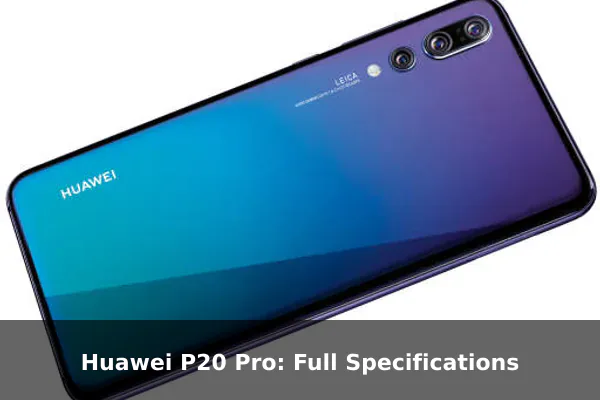
The Huawei P20 Pro has a compact flagship feel by modern standards. Its 155 x 73.9 x 7.8 mm body and 180 g weight make it slimmer and lighter than many recent large-screen phones, while the glass front, glass back, and aluminum frame keep the construction premium. Gorilla Glass 5 protection is listed for the front, and the IP67 rating means protection against dust and temporary immersion in up to 1 meter of water for 30 minutes.
The front-mounted fingerprint sensor is a notable design detail. Many newer phones moved fully to under-display sensors or side-mounted readers, but the P20 Pro keeps a physical sensor area below the screen. That may reduce the all-screen look, yet it gives the phone a predictable unlock point and contributes to its identity as a late-2010s flagship. The SIM listing points to Nano-SIM and dual Nano-SIM variants, so buyers should confirm the exact model code before purchase.
OLED Display Experience
The 6.1-inch OLED display is one of the P20 Pro’s major strengths. Its 1080 x 2240 pixel resolution, 18.7:9 aspect ratio, and roughly 408 ppi density deliver sharp enough text and interface rendering for everyday use. The screen-to-body ratio is listed at about 82.0%, which was competitive at launch even if newer phones now push slimmer bezels and higher refresh rates.
The source test data lists an infinite nominal contrast ratio and a 4.087 sunlight contrast result, which supports the phone’s reputation for strong contrast and outdoor usability. The main limitation for modern buyers is that the P20 Pro does not offer the high-refresh-rate experience now common on many mid-range and flagship Android phones. If smooth scrolling is a top priority, newer 90 Hz or 120 Hz phones will feel more fluid.
Performance and Storage
The Kirin 970 chipset is built on a 10 nm process and pairs four Cortex-A73 performance cores with four Cortex-A53 efficiency cores. The Mali-G72 MP12 GPU handles graphics, while the listed UFS 2.1 storage helps the phone feel more responsive than devices using slower storage standards. The available memory configurations include 64GB with 6GB RAM, 128GB with 6GB or 8GB RAM, and 256GB with 6GB or 8GB RAM.
Benchmark data places the phone at 209884 in AnTuTu v7, 6679 in GeekBench v4.4, and 21fps in GFXBench ES 3.1 onscreen. Those figures reflect flagship-class performance for its generation, but they should not be compared directly with newer benchmark versions. For messaging, browsing, video streaming, navigation, and casual photography, the hardware remains capable. For demanding games, heavy multitasking, and long-term app support, a newer chipset will age better.
Leica Triple Camera System
The Huawei P20 Pro’s camera system is the headline feature. It combines a 40 MP wide camera with OIS, an 8 MP telephoto camera with OIS and 3x optical zoom, and a 20 MP black-and-white wide camera. The setup is supported by Laser AF, a color spectrum sensor, Leica optics, LED flash, HDR, and panorama. This combination made the phone stand out because it treated mobile photography as a multi-sensor system rather than a simple single-camera upgrade.
Video recording reaches 4K at 30fps, 1080p at 60fps, 1080p at 30fps with gyro-EIS, and 720p at 960fps for slow motion. The 24 MP front camera records 1080p at 30fps and is also listed with Leica optics. Camera buyers should remember that processing style matters: the P20 Pro often favors punchy, contrast-rich output, while newer phones may offer better HDR consistency, faster processing, larger sensors, and more advanced computational photography.
Battery Life and Charging
The 4000 mAh non-removable Li-Po battery was large for a 2018 flagship and remains one of the P20 Pro’s most practical specifications. The source test data lists an old endurance rating of 89 hours, which suggests strong mixed-use stamina for its generation. Combined with a 1080p-class OLED display and Kirin 970 hardware, the battery capacity gives the phone a sensible balance between size and runtime.
Charging is rated at 22.5W wired, with a listed 58% charge in 30 minutes. That is no longer fast by current flagship standards, but it is still useful for daily top-ups. The main caution is battery aging. Since the phone was released in April 2018, any used unit in 2026 may have significantly reduced battery health unless the battery has been replaced with a quality part.
Software and Long-Term Use
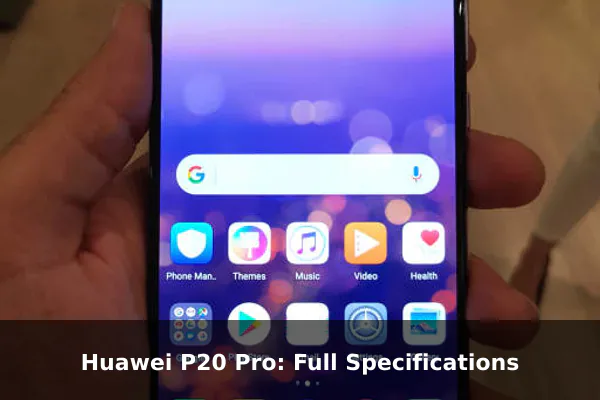
The P20 Pro launched with Android 8.1 Oreo and EMUI 8.1, with the source data listing upgrades to Android 10 and EMUI 12. That upgrade path is important because it gives the phone a more modern interface than its launch software, but it does not make it equal to current Android releases. App compatibility should remain acceptable for many daily tasks, though security patch age and regional firmware availability are important considerations.
For buyers who rely on banking apps, workplace authentication, or long-term security updates, a newer supported phone is a safer choice. For users who mainly need camera use, offline media, Wi-Fi browsing, or a backup phone, the P20 Pro’s software status may be acceptable if the device is clean, reset properly, and running stable firmware.
Connectivity and Audio
The P20 Pro supports GSM, HSPA, and LTE, with LTE Cat16 rated at 1024/150 Mbps and broad 4G band coverage in the listed source data. It also includes Wi-Fi 802.11 a/b/g/n/ac, Bluetooth 4.2 with aptX HD, GPS, GLONASS, GALILEO, NFC, an infrared port, and USB Type-C 3.1. The lack of 5G is expected for a 2018 model and is the biggest connectivity gap versus newer phones.
Audio features include stereo speakers and 32-bit/384kHz audio support, but there is no 3.5mm headphone jack and no FM radio. The loudspeaker test data lists Voice 71dB, Noise 69dB, and Ring 91dB, while audio quality data lists Noise -92.1dB and Crosstalk -92.1dB. For wired headphones, users will need USB-C audio or an adapter.
Who Should Buy It?
The Huawei P20 Pro makes the most sense for buyers who want an older premium Huawei phone with strong photography credentials, OLED contrast, water resistance, NFC, infrared control, and solid battery capacity. It is especially interesting for users who value Huawei’s Leica-era camera tuning and do not need 5G or the newest Android version.
It is less suitable for users who want years of fresh software updates, high-refresh gaming, expandable storage, a headphone jack, or guaranteed battery condition. Since there is no microSD card slot, choosing the right internal storage variant matters. The 128GB and 256GB models are more practical than the 64GB version for long-term photo and video use.
Conclusion
The Huawei P20 Pro is a discontinued but still notable flagship built around a Leica triple camera, OLED display, Kirin 970 performance, IP67 protection, and a 4000 mAh battery. It is worth considering as a used camera-focused Android phone if the price is low, the battery is healthy, and software limitations are acceptable; otherwise, a newer mid-range or flagship model is the better recommendation.
References
- Huawei Consumer – HUAWEI P20 Pro Specifications (archived official global page) – Archived copy of Huawei's official global specifications page; best anchor for core specs such as display, dimensions, chipset, memory, cameras, battery, connectivity, and colors.
- Huawei Press Center – Huawei Unveils the HUAWEI P20 and HUAWEI P20 Pro – Official launch announcement confirming release context, camera system details, Kirin 970, EMUI 8.1 based on Android 8.1, and key product positioning.
- Huawei Support Singapore – HUAWEI CLT Mobile Phone User Guide – Official Huawei support page for the P20 Pro CLT models, useful for confirming model variants, user-guide documentation, and applicable EMUI version.
- GSMArena – Huawei P20 Pro Full Phone Specifications – Well-known phone-specification reference useful for cross-checking complete spec fields, network bands, launch details, and variant information against official sources.
- AnandTech – The Huawei P20 & P20 Pro Review – Detailed technical review with a specification table and hardware analysis, useful for validating SoC, display, memory, battery, camera, modem, and connectivity details.
