
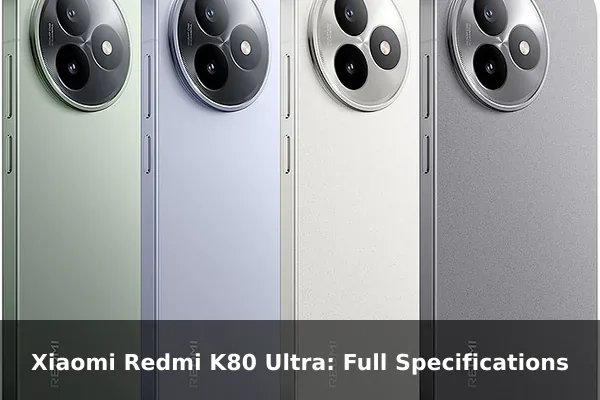
The Xiaomi Redmi K80 Ultra arrives as a performance-first flagship killer, packing the MediaTek Dimensity 9400+ into a body that still aims for a mainstream price. Announced on June 26, 2025, it pairs a large 6.83-inch OLED display, a high-capacity 7410 mAh silicon-carbon battery, and 100W wired charging, positioning itself as one of the most aggressively specced devices in its bracket. With a starting price of around 310 EUR, it targets buyers who want raw power without paying true ultra-flagship money.
This article breaks down what the Redmi K80 Ultra offers across design, display, performance, cameras, battery, software, and connectivity, and explains who stands to benefit most. Specifications here are drawn from the source listing and should be confirmed against Xiaomi’s official Redmi K80 Ultra specs page before purchase, since regional variants and pricing can differ.
Full Specifications
Network
| Technology | GSM / CDMA / HSPA / CDMA2000 / LTE / 5G |
| 2G bands | GSM 850 / 900 / 1800 / 1900 |
| CDMA 800 | |
| 3G bands | HSDPA 800 / 850 / 900 / 1700(AWS) / 2100 |
| CDMA2000 1x | |
| 4G bands | 1, 3, 4, 5, 7, 8, 18, 19, 26, 28, 34, 38, 39, 40, 41, 42, 48, 66 |
| 5G bands | 1, 3, 5, 7, 8, 26, 28, 38, 40, 41, 48, 66, 77, 78 SA/NSA |
| Speed | HSPA, LTE, 5G |
Launch
| Announced | 2025, June 26 |
| Status | Available. Released 2025, June 26 |
Body
| Dimensions | 163.1 x 77.9 x 8.2 mm (6.42 x 3.07 x 0.32 in) |
| Weight | 219 g (7.72 oz) |
| Build | Glass front, aluminum frame |
| SIM | Nano-SIM + Nano-SIM |
| IP68 dust tight and water resistant (immersible up to 2m for 30 min) |
Display
| Type | OLED, 68B colors, 144Hz, Dolby Vision, HDR10+, HDR Vivid, 1800 nits (HBM), 3200 nits (peak) |
| Size | 6.83 inches, 114.5 cm2 (~90.2% screen-to-body ratio) |
| Resolution | 1280 x 2772 pixels, 19.5:9 ratio (~447 ppi density) |
| Protection | Scratch/drop-resistant glass |
Platform
| OS | Android 15, HyperOS 2 |
| Chipset | Mediatek Dimensity 9400+ (3 nm) |
| CPU | Octa-core (1×3.63 GHz Cortex-X925 & 3×3.3 GHz Cortex-X4 & 4×2.4 GHz Cortex-A720) |
| GPU | Immortalis-G925 |
Memory
| Card slot | No |
| Internal | 256GB 12GB RAM, 256GB 16GB RAM, 512GB 12GB RAM, 512GB 16GB RAM, 1TB 16GB RAM |
| UFS 4.1 |
Main Camera
| Dual | 50 MP, f/1.9, 23mm (wide), 1/1.55", 1.0µm, PDAF, OIS 8 MP, 119˚ (ultrawide), 1/4.0", 1.12µm |
| Features | Color spectrum sensor, Dual-LED dual-tone flash, HDR, panorama |
| Video | 8K@30fps, 4K@30/60fps, 1080p@30/60/120/240/960fps, gyro-EIS |
Selfie camera
| Single | 20 MP, (wide), 1/2.0", 0.8µm |
| Features | HDR |
| Video | 1080p@30/60fps |
Sound
| Loudspeaker | Yes, with stereo speakers |
| 3.5mm jack | No |
| 24-bit/192kHz Hi-Res & Hi-Res Wireless audio |
Comms
| WLAN | Wi-Fi 802.11 a/b/g/n/ac/6/7, dual-band, Wi-Fi Direct |
| Bluetooth | 5.4, A2DP, LE, LHDC 5 |
| Positioning | GPS (L1+L5), BDS (B1I+B1C+B2a+B2b), GALILEO (E1+E5a+E5b), QZSS (L1+L5), NavIC, GLONASS |
| NFC | Yes |
| Infrared port | Yes |
| Radio | Unspecified |
| USB | USB Type-C |
Features
| Sensors | Fingerprint (under display, ultrasonic), accelerometer, gyro, proximity, compass |
Battery
| Type | Si/C Li-Ion 7410 mAh |
| Charging | 100W wired, PD3.0 Bypass charging |
Misc
| Colors | Gray, White, Blue, Green |
| Price | About 310 EUR |
Price and Availability
The Xiaomi Redmi K80 Ultra offers a compelling combination of features and performance. While the base price is around €310, the actual cost may vary depending on your location and retailer. Below, you’ll find the approximate price of the Xiaomi Redmi K80 Ultra converted into various currencies. Please note that these are estimates based on recent exchange rates as of June 10, 2026 and may not reflect the exact price you’ll find at a retailer.
- United States: $358
- Japan: ¥57,383
- United Kingdom: £268
- Australia: A$509
- Canada: C$499
- Taiwan: NT$11,305
- Denmark: kr2.314
- Saudi Arabia: ﷼1,343
- South Korea: ₩546,119
- Germany: €310
- Brazil: R$1.853
- Vietnam: ₫9.384.387
- Kenya: KSh 46,369
- India: ₹34,163
- Indonesia: Rp 6.451.097
- Nigeria: ₦484,854
- Pakistan: ₨99,575
- Philippines: ₱22,037
- Bangladesh: ৳৪৩,৯৭৬
Value: What 310 EUR Buys You
At roughly 310 EUR, the Redmi K80 Ultra undercuts most rivals that ship with a flagship-tier chipset. You get the MediaTek Dimensity 9400+ on a 3 nm process, UFS 4.1 storage, up to 16GB of RAM, IP68 protection, and a 7410 mAh battery, all in one package. For shoppers who prioritize sustained performance and battery life over a polished camera system, the value proposition is hard to match. It is best understood as a spec-sheet champion that concentrates its budget on the components enthusiasts care about most.
Design and Build Quality
The K80 Ultra measures 163.1 x 77.9 x 8.2 mm and weighs 219 g, so it is a substantial handset that reflects its large battery and display. The build combines a glass front with an aluminum frame, and Xiaomi rates it IP68 for dust resistance and immersion in up to 2 m of water for 30 minutes. Dual Nano-SIM support is included, but there is no microSD card slot, so you should choose your storage capacity carefully at purchase. Color options are Gray, White, Blue, and Green.
Display: Big, Bright, and Fast
The standout feature is the 6.83-inch OLED panel with a 1280 x 2772 resolution (about 447 ppi) and a 144Hz refresh rate. It supports Dolby Vision, HDR10+, and HDR Vivid, and reaches up to 1800 nits in high-brightness mode with a 3200-nit peak, which should make outdoor visibility and HDR video genuinely impressive. With a roughly 90.2% screen-to-body ratio and scratch- and drop-resistant glass, it is well suited to gaming, streaming, and everyday reading. The high refresh rate combined with the bright panel makes this one of the most compelling displays in the price range.
Performance and Storage
Powering the phone is the MediaTek Dimensity 9400+, built on a 3 nm node with an octa-core layout led by a 3.63 GHz Cortex-X925 prime core, three Cortex-X4 cores, and four Cortex-A720 efficiency cores, paired with the Immortalis-G925 GPU. That is a genuine flagship-class platform capable of demanding games at high frame rates. Storage tiers run from 256GB with 12GB RAM up to 1TB with 16GB RAM, all using fast UFS 4.1. For heavy multitaskers and mobile gamers, the higher RAM configurations leave plenty of headroom.
Camera System
The rear setup is a dual camera rather than a sprawling array: a 50 MP f/1.9 wide sensor (1/1.55″, with PDAF and OIS) and an 8 MP 119-degree ultrawide. A color spectrum sensor and dual-LED dual-tone flash support white balance and low-light shots, and video tops out at 8K@30fps, with 4K up to 60fps and 1080p slow motion up to 960fps plus gyro-EIS. The front camera is a 20 MP wide unit recording 1080p video. This is a competent but not headline-grabbing imaging package; the focus is clearly on the main sensor and stabilized video rather than telephoto reach.
Battery and Charging
A large 7410 mAh silicon-carbon (Si/C) Li-Ion battery anchors the K80 Ultra, which is well above the typical flagship capacity and should comfortably deliver all-day, often multi-day, endurance. Charging is handled by a 100W wired solution with PD3.0 and bypass charging, the latter useful for reducing heat during long gaming sessions. There is no wireless charging listed, but the combination of a huge cell and fast wired refueling is a strong endurance story for power users.
Software Experience
The phone ships with Android 15 layered under HyperOS 2, Xiaomi’s current software platform. HyperOS 2 brings the company’s refreshed interface, system optimizations, and connected-device features. Buyers should verify the expected update window for security patches and OS upgrades on Xiaomi’s official channels, as software support length is a meaningful factor for a device you intend to keep for several years.
Connectivity and Extras
Connectivity is comprehensive: Wi-Fi 7, Bluetooth 5.4 with LHDC 5, NFC, an infrared port, and USB Type-C. Positioning covers dual-band GPS (L1+L5), BDS, Galileo, QZSS, NavIC, and GLONASS for accurate navigation. The phone uses an under-display ultrasonic fingerprint sensor, generally faster and more reliable than optical alternatives, alongside stereo speakers and 24-bit/192kHz Hi-Res audio. Note there is no 3.5mm headphone jack, so wireless or USB-C audio is required.
Who Should Buy the Redmi K80 Ultra?
This phone is aimed squarely at mobile gamers, heavy multitaskers, and value-conscious enthusiasts who want flagship silicon, a fast bright screen, and exceptional battery life without spending top-tier money. It is less ideal for photography purists who want a versatile multi-lens camera or telephoto zoom, or for buyers who need wireless charging. If your priorities are speed, endurance, and screen quality per euro, it is an outstanding fit.
Conclusion
The Xiaomi Redmi K80 Ultra delivers a remarkable concentration of high-end hardware, a Dimensity 9400+ chipset, a 144Hz OLED display, a 7410 mAh battery with 100W charging, and Wi-Fi 7, at a price that few competitors can match. Its compromises are a streamlined dual-camera system and the absence of wireless charging and a card slot. For gamers, power users, and spec-driven buyers seeking maximum performance and endurance for the money, it earns a strong recommendation; confirm the exact variant, pricing, and software support on Xiaomi’s official pages before buying.
Official references
- Xiaomi China REDMI K80 Ultra Specifications – Official manufacturer specifications page for the REDMI K80 Ultra, covering hardware details such as display, dimensions, cameras, battery, charging, memory variants, and connectivity.
- Xiaomi China REDMI K80 Ultra Product Page – Official product overview page for confirming naming, feature claims, colors, availability context, pricing, and manufacturer footnotes.
- MediaTek Dimensity 9400 Plus Official Materials (mediatek.com) – Primary chipset-maker source for verifying the Dimensity 9400 Plus platform, CPU/GPU architecture, AI features, wireless capabilities, and supported memory/display/camera technologies.
- China MIIT / TENAA Telecom Equipment Certification Database (miit.gov.cn) – Primary regulatory source for checking China network-access certification, model identifiers, radio/network support, and certified device details.
- Xiaomi HyperOS Official Site – Official Xiaomi source for HyperOS version information, supported-device rollout details, and current software context for the device.
