
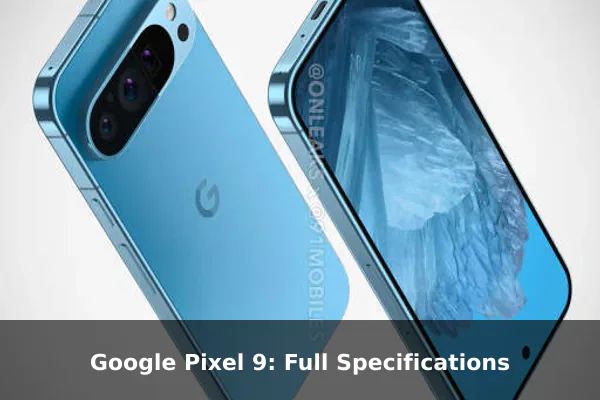
The Google Pixel 9 is the standard model in Google’s 2024 flagship phone family, but it is not positioned like a stripped-down entry point. It keeps the Tensor G4 platform, a bright 120Hz OLED display, a high-resolution dual rear camera system, IP68 protection, and Google’s long software support promise in a more compact body than the larger Pro XL model.
This specs-focused overview looks at the Pixel 9 from a practical buying angle: what the hardware means in daily use, where the standard model still feels premium, and which compromises matter if you are comparing it with Pro-tier flagships, camera phones, and long-support Android alternatives.
Full Specifications
Network
| Technology: | GSM / HSPA / LTE / 5G |
| 2G bands: | GSM 850 / 900 / 1800 / 1900 |
| 3G bands: | HSDPA 800 / 850 / 900 / 1700(AWS) / 1900 / 2100 |
| 4G bands: | 1, 2, 3, 4, 5, 7, 8, 12, 13, 14, 17, 18, 19, 20, 25, 26, 28, 29, 30, 38, 40, 41, 48, 66, 71 – G2YBB |
| 1, 2, 3, 4, 5, 7, 8, 12, 13, 14, 17, 18, 19, 20, 21, 25, 26, 28, 29, 30, 32, 38, 39, 40, 41, 42, 48, 66, 71, 75 – GUR25 | |
| 5G bands: | 1, 2, 3, 5, 7, 8, 12, 14, 20, 25, 26, 28, 29, 30, 38, 40, 41, 48, 66, 70, 71, 77, 78, 258, 260, 261 SA/NSA/Sub6/mmWave – G2YBB |
| 1, 2, 3, 5, 7, 8, 12, 14, 20, 25, 26, 28, 30, 38, 40, 41, 66, 71, 75, 76, 77, 78, 79 SA/NSA/Sub6 – GUR25 | |
| Speed: | HSPA, LTE (CA), 5G |
Launch
| Announced: | 2024, August 13 |
| Status: | Available. Released 2024, August 22 |
Body
| Dimensions: | 152.8 x 72 x 8.5 mm (6.02 x 2.83 x 0.33 in) |
| Weight: | 198 g (6.98 oz) |
| Build: | Glass front (Gorilla Glass Victus 2), glass back (Gorilla Glass Victus 2), aluminum frame |
| SIM: | Nano-SIM + eSIM |
| IP68 dust tight and water resistant (immersible up to 1.5m for 30 min) |
Display
| Type: | OLED, 120Hz, HDR10+, 1800 nits (HBM), 2700 nits (peak) |
| Size: | 6.3 inches, 94.7 cm2 (~86.1% screen-to-body ratio) |
| Resolution: | 1080 x 2424 pixels, 20:9 ratio (~422 ppi density) |
| Protection: | Corning Gorilla Glass Victus 2, Mohs level 4 |
Platform
| OS: | Android 14, upgradable to Android 15, up to 7 major Android upgrades |
| Chipset: | Google Tensor G4 (4 nm) |
| CPU: | Octa-core (1×3.1 GHz Cortex-X4 & 3×2.6 GHz Cortex-A720 & 4×1.92 GHz Cortex-A520) |
| GPU: | Mali-G715 MC7 |
Memory
| Card slot: | No |
| Internal: | 128GB 12GB RAM, 256GB 12GB RAM |
| UFS 3.1 |
Main Camera
| Dual: | 50 MP, f/1.7, 25mm (wide), 1/1.31″, 1.2µm, dual pixel PDAF, OIS 48 MP, f/1.7, 123˚ (ultrawide), 1/2.55″, dual pixel PDAF |
| Features: | Single-zone Laser AF, LED flash, Pixel Shift, Ultra-HDR, panorama, Best Take |
| Video: | 4K@24/30/60fps, 1080p@24/30/60/120/240fps; gyro-EIS, OIS, 10-bit HDR |
Selfie camera
| Single: | 10.5 MP, f/2.2, 20mm (ultrawide), 1/3.1″, 1.22µm, PDAF |
| Features: | HDR, panorama |
| Video: | 4K@30/60fps, 1080p@30/60fps |
Sound
| Loudspeaker: | Yes, with stereo speakers |
| 3.5mm jack: | No |
Comms
| WLAN: | Wi-Fi 802.11 a/b/g/n/ac/6e/7, tri-band |
| Bluetooth: | 5.3, A2DP, LE, aptX HD |
| Positioning: | GPS (L1+L5), GLONASS, GALILEO, BDS, QZSS, NavIC |
| NFC: | Yes |
| Radio: | No |
| USB: | USB Type-C 3.2 |
Features
| Sensors: | Fingerprint (under display, ultrasonic), accelerometer, gyro, proximity, compass, barometer |
| Satellite SOS service Circle to Search |
Battery
| Type: | Li-Ion 4700 mAh |
| Charging: | 27W wired, PD3.0, PPS, 55% in 30 min 15W wireless (w/ Pixel Stand) 12W wireless (w/ Qi compatible charger) Reverse wireless Bypass charging |
Misc
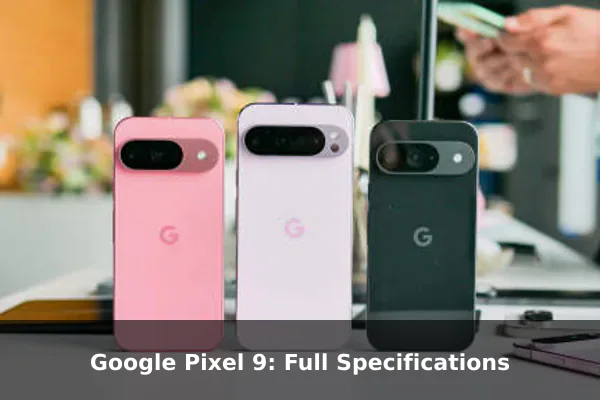
| Colors: | Obsidian, Porcelain, Wintergreen, Peony |
| Models: | G2YBB, GUR25, G1B60 |
| SAR EU: | 0.99 W/kg (head) 1.40 W/kg (body) |
| Price: | € 486.00 / $ 519.95 / £ 436.36 / ₹ 61,025 |
Our Tests
| Performance: | AnTuTu: 1224020 (v10) GeekBench: 4489 (v6) 3DMark: 2587 (Wild Life Extreme) |
| Display: | 2232 nits max brightness (measured) |
| Loudspeaker: | -25.0 LUFS (Very good) |
| Battery: | Active use score 13:05h |
EU LABEL
| Energy: | Class A |
| Battery: | 49:12h endurance, 1000 cycles |
| Free fall: | Class A (270 falls) |
| Repairability: | Class B |
Price and Availability
The Google Pixel 9 offers a compelling combination of features and performance. While the base price is around €486, the actual cost may vary depending on your location and retailer. Below, you’ll find the approximate price of the Google Pixel 9 converted into various currencies. Please note that these are estimates based on recent exchange rates as of August 10, 2026 and may not reflect the exact price you’ll find at a retailer.
- United States: $562
- Japan: ¥88,657
- United Kingdom: £416
- Australia: A$795
- Canada: C$784
- Taiwan: NT$18,115
- Denmark: kr3.626
- Saudi Arabia: ﷼2,106
- South Korea: ₩792,526
- Germany: €486
- Brazil: R$2.857
- Vietnam: ₫14.613.510
- Kenya: KSh 72,547
- India: ₹53,424
- Indonesia: Rp 10.035.767
- Nigeria: ₦765,098
- Pakistan: ₨156,067
- Philippines: ₱34,157
- Bangladesh: ৳৬৯,৩৮৬
Why Should You Buy the Google Pixel 9?
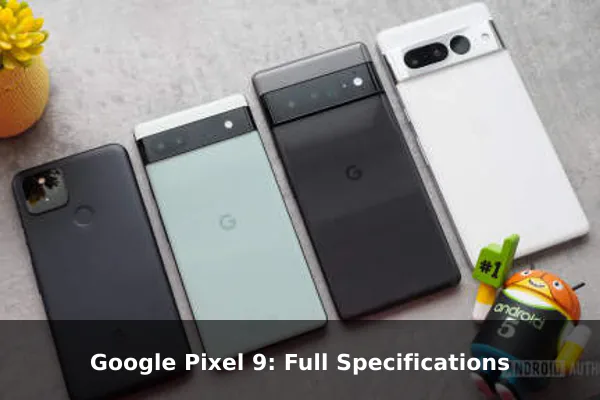
The Pixel 9 makes the most sense for buyers who want Google’s current core phone experience without moving to a very large handset. Its strongest appeal is balance: a 6.3-inch display, 12GB of RAM, Tensor G4 processing, a 50MP main camera, a 48MP ultrawide camera, and a seven-generation Android upgrade commitment. That combination gives it a clear identity as a compact mainstream flagship rather than a budget Pixel or a camera-only upgrade.
Compared with many specification-heavy Android phones, the Pixel 9 is less about chasing the largest battery, highest charging wattage, or most camera sensors. Its value is in practical flagship features that are easy to notice every day: clean software, dependable imaging, bright outdoor visibility, fast biometric unlocking, strong wireless support, and long-term updates. For users who keep a phone for several years, that software window is one of its most important advantages.
Design and Durability
The Pixel 9 uses a glass-and-aluminum build with Gorilla Glass Victus 2 on both the front and back, giving it the material profile expected from a modern premium phone. At 152.8 x 72 x 8.5 mm and 198 g, it is not an ultra-light compact device, but it remains easier to handle than large-screen flagships. The squared-off frame and camera bar design also give it a distinct Pixel look without relying on a folding mechanism or oversized body.
Durability is another major part of the package. The IP68 rating means the phone is dust tight and rated for immersion in water up to 1.5 meters for 30 minutes under specified test conditions. The EU label information is also notable, with Class A energy performance, Class A free-fall resistance, and Class B repairability. Those ratings do not make the phone indestructible, but they help position it as a device designed for longer ownership.
Display Quality
The 6.3-inch OLED display is one of the Pixel 9’s strongest everyday features. It supports a 120Hz refresh rate, HDR10+, 1800 nits high-brightness mode, and a listed 2700 nits peak brightness. The measured display result in the supplied test data reaches 2232 nits, which is strong for outdoor readability and HDR viewing. Resolution is 1080 x 2424 pixels, producing around 422 ppi, so text and interface elements should look sharp without pushing the power demands of a higher-resolution panel.
This is a useful display size for users who want a flagship-class screen but do not want a tablet-like phone. The 20:9 aspect ratio keeps scrolling content comfortable, while the roughly 86.1% screen-to-body ratio gives the front a modern look. Gorilla Glass Victus 2 protection is welcome, though the Mohs level 4 note shows that users should still consider a screen protector if scratch resistance is a priority.
Tensor G4 Performance
The Pixel 9 runs on Google’s Tensor G4 chipset, built on a 4 nm process and paired with 12GB of RAM. Its CPU layout includes one Cortex-X4 prime core, three Cortex-A720 performance cores, and four Cortex-A520 efficiency cores, while graphics are handled by the Mali-G715 MC7. In the supplied test data, the phone posts an AnTuTu v10 score of 1,224,020, a GeekBench v6 score of 4,489, and a 3DMark Wild Life Extreme score of 2,587.
Those numbers place the Pixel 9 in clear flagship territory for daily responsiveness, multitasking, image processing, and AI-driven features. Buyers focused mainly on sustained gaming performance may still compare it carefully with phones built around gaming-oriented Snapdragon platforms, but for general Android use the hardware is comfortably capable. Storage options are 128GB or 256GB, both with 12GB RAM and UFS 3.1 storage. There is no microSD card slot, so choosing the right storage size at purchase matters.
Camera System
The rear camera setup is straightforward but serious. The main camera uses a 50MP wide sensor with an f/1.7 aperture, dual pixel PDAF, and optical image stabilization. The second camera is a 48MP ultrawide with a 123-degree field of view and dual pixel PDAF. Instead of adding a lower-value macro or depth camera, Google gives the Pixel 9 two high-resolution rear cameras that cover the most common shooting needs.
Camera features include single-zone Laser AF, LED flash, Pixel Shift, Ultra-HDR, panorama, and Best Take. Video support is also strong, with 4K recording at 24, 30, and 60fps, plus 1080p options up to 240fps. Gyro-EIS, OIS, and 10-bit HDR support help make the phone more versatile for handheld video. The main limitation is the lack of a dedicated telephoto camera, so buyers who frequently shoot distant subjects may prefer a Pro model.
Selfie and Video Calling
The front camera is a 10.5MP ultrawide unit with PDAF, HDR, panorama support, and video recording up to 4K at 60fps. Autofocus on the selfie camera is an important practical advantage for video calls, vlogging, and group selfies because it helps keep faces sharper at different distances.
The 20mm ultrawide framing also fits the Pixel’s role as a social and travel-friendly phone. It is not the highest-resolution selfie camera on paper, but Google’s image processing and autofocus support make it more useful than the number alone suggests. For buyers who care about consistent front-camera video, the 4K60 capability is a strong point.
Battery and Charging
The Pixel 9 carries a 4700 mAh battery, and the supplied active use score is 13:05 hours. The EU label lists 49:12 hours of endurance and 1000 battery cycles, giving buyers another way to judge long-term battery expectations. As always, real endurance will vary depending on signal strength, camera use, navigation, display brightness, and 5G activity.
Charging support includes 27W wired charging with PD3.0 and PPS, with a listed 55% charge in 30 minutes. Wireless charging reaches 15W with the Pixel Stand and 12W with a Qi-compatible charger, while reverse wireless charging is also supported. Bypass charging is a useful extra for heat management during plugged-in use, especially for longer sessions such as navigation or gaming.
Software and AI Features
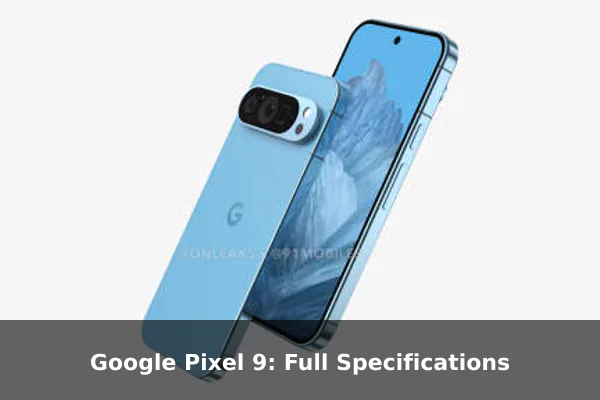
The Pixel 9 launched with Android 14 and is listed as upgradable to Android 15, with up to seven major Android upgrades. This is one of the most important reasons to consider it over many Android rivals. A long update policy improves the phone’s ownership value, keeps security support relevant, and helps the device stay current as Android features evolve.
Google also positions the Pixel 9 around its AI features, including Circle to Search and Pixel camera tools such as Best Take. The appeal here is not just raw chipset speed, but how tightly Google can connect hardware, Android, cloud services, and on-device intelligence. Buyers who already use Google Photos, Gmail, Maps, Assistant-style features, and Android’s Pixel-first tools will get the most value from that ecosystem.
Connectivity and Network Coverage
Connectivity is broad, with GSM, HSPA, LTE, and 5G support, plus model-specific 4G and 5G band lists. The G2YBB variant includes sub-6 and mmWave 5G bands, while the GUR25 variant is listed with sub-6 5G support. This distinction matters for buyers importing the device or comparing regional versions, because network performance can depend on the exact model and carrier bands.
Wireless features are comprehensive: Wi-Fi 7, tri-band Wi-Fi, Bluetooth 5.3 with aptX HD, NFC, USB Type-C 3.2, and multi-constellation positioning with GPS L1+L5, GLONASS, GALILEO, BDS, QZSS, and NavIC. There is no FM radio and no 3.5mm headphone jack, but stereo speakers are included, and the supplied loudspeaker test result of -25.0 LUFS is rated very good.
Who Should Buy It?
The Pixel 9 is best for Android users who want a polished, compact flagship with excellent software support, a strong main-and-ultrawide camera setup, bright display performance, and Google-first features. It is also a good fit for buyers who care more about long-term usability than maximum charging speed or the longest possible spec sheet.
It is less ideal for users who need expandable storage, a headphone jack, a dedicated telephoto camera, or the absolute fastest gaming-focused chipset. Those buyers should compare it with Pro camera phones, gaming phones, or larger Android flagships. For most everyday users, though, the Pixel 9 offers a focused mix of premium hardware and long software life in a size that remains practical.
Conclusion
The Google Pixel 9 is a strong standard flagship because it keeps the essentials that matter most: a bright 120Hz OLED screen, Tensor G4 performance, dependable dual rear cameras, IP68 durability, wireless charging, modern connectivity, and long Android upgrade support. Choose it if you want the core Pixel flagship experience in a manageable size without paying mainly for Pro-only extras.
References
- Google Store – Pixel 9 Tech Specs – Primary source for Pixel 9 display, dimensions, battery, cameras, processor, memory, storage, connectivity, durability, OS, and in-box contents.
- Google Pixel Phone Help – Pixel phone hardware tech specs – Official Google support documentation for Pixel 9 hardware specifications, regional measurements, network bands, and technical footnotes.
- Google Pixel Phone Help – Safety & regulatory guide for Pixel 9 series – Official safety and regulatory source for Pixel 9 SAR values, compliance details, model numbers, warranty, and regional regulatory information.
- Google Pixel Phone Help – Pixel software update policy – Official source for Pixel 9 OS, security update, and Pixel Drop support duration.
- Google Blog – The new Pixel 9 phones bring you the best of Google AI – Official launch article confirming Pixel 9 series announcement context, launch positioning, starting prices, availability timing, Tensor G4, AI features, and camera/display upgrades.
