
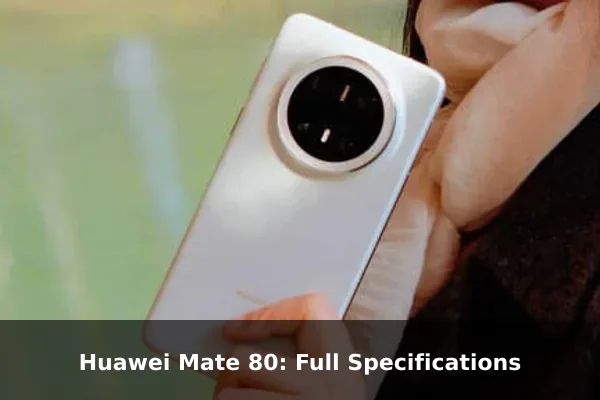
The Huawei Mate 80 arrives as the accessible entry point into Huawei’s flagship Mate 80 family, announced on 25 November 2025 and positioned to deliver premium hardware without stepping up to the Pro or Pro Max tiers. Built around the in-house Kirin 9020 chipset, HarmonyOS 6.0, and a large 6.75-inch LTPO OLED panel, it targets buyers who want Huawei’s signature imaging and durability at a starting price of roughly 570 EUR.
Unlike the many mainstream Android and iPhone models that dominate this segment, the Mate 80 leans on Huawei’s own silicon, satellite communication features, and an aggressive triple-camera system with a 5.5x periscope. This article looks at where the Mate 80 makes sense, how its trade-offs compare to rivals, and which type of user gets the most from it.
Full Specifications
Network
| Technology: | GSM / CDMA / HSPA / CDMA2000 / LTE / 5G |
| 2G bands: | GSM 850 / 900 / 1800 / 1900 |
| CDMA 800 | |
| 3G bands: | HSDPA 800 / 850 / 900 / 1700(AWS) / 1900 / 2100 |
| CDMA2000 1x | |
| 4G bands: | LTE |
| 5G bands: | SA/NSA |
| Speed: | HSPA, LTE, 5G |
Launch
| Announced: | 2025, November 25 |
| Status: | Available. Released 2025, November 25 |
Body
| Dimensions: | 161.9 x 76 x 8 mm (6.37 x 2.99 x 0.31 in) |
| Weight: | 217 g (7.65 oz) |
| Build: | Glass front, aluminum alloy frame, fiber-reinforced plastic back |
| SIM: | Nano-SIM + Nano-SIM |
| IP68/IP69 dust tight and water resistant (high pressure water jets; immersible up to 6m for 30 min) |
Display
| Type: | LTPO OLED, 1B colors, 120Hz, 1440Hz PWM, HDR Vivid |
| Size: | 6.75 inches, 110.3 cm2 (~89.7% screen-to-body ratio) |
| Resolution: | 1280 x 2832 pixels (~460 ppi density) |
| Protection: | Huawei Kunlun Glass 2 |
Platform
| OS: | HarmonyOS 6.0 |
| Chipset: | Kirin 9020 (7 nm) |
| CPU: | Octa-core (1×2.5 GHz & 3×2.15 GHz & 4×1.6 GHz) |
| GPU: | Maleoon 920 |
Memory
| Card slot: | No |
| Internal: | 256GB 12GB RAM, 512GB 12GB RAM, 512GB 16GB RAM |
Main Camera
| Triple: | 50 MP, f/1.4-f/4.0, 24mm (wide), PDAF, OIS 12 MP, f/3.4, 125mm (periscope telephoto), PDAF, OIS, 5.5x optical zoom 40 MP, f/2.2, 13mm, 120˚ (ultrawide), PDAF |
| Features: | Laser AF, color spectrum sensor, LED flash, panorama, HDR |
| Video: | 4K, 1080p@240fps, HDR, gyro-EIS, OIS, HDR Vivid |
Selfie camera
| Single: | 13 MP, f/2.0, 18mm (ultrawide), AF TOF 3D, (depth/biometrics sensor) |
| Features: | HDR, panorama |
| Video: | 4K, 1080p, HDR, gyro-EIS |
Sound
| Loudspeaker: | Yes, with stereo speakers |
| 3.5mm jack: | No |
| High-definition audio |
Comms
| WLAN: | Wi-Fi 802.11 a/b/g/n/ac/6/7, dual-band, Wi-Fi Direct |
| Bluetooth: | 6.0, A2DP, LE, L2HC |
| Positioning: | GPS (L1+L5), GLONASS (L1), BDS (B1I+B1c+B2a+B2b), GALILEO (E1+E5a+E5b), QZSS (L1+L5), NavIC |
| NFC: | Yes |
| Infrared port: | Yes |
| Radio: | No |
| USB: | USB Type-C 3.1, OTG, DisplayPort 1.2 |
Features
| Sensors: | Face ID, fingerprint (side-mounted), accelerometer, gyro, proximity, barometer, compass |
| BDS Satellite Calling and Messaging – China only |
Battery
| Type: | 5750 mAh |
| Charging: | 66W wired 50W wireless Reverse wireless 5W reverse wired |
Misc
| Colors: | Black, White, Green, Gold |
| Models: | VYG-AL00 |
| Price: | About 570 EUR |
Price and Availability
The Huawei Mate 80 offers a compelling combination of features and performance. While the base price is around €570, the actual cost may vary depending on your location and retailer. Below, you’ll find the approximate price of the Huawei Mate 80 converted into various currencies. Please note that these are estimates based on recent exchange rates as of July 10, 2026 and may not reflect the exact price you’ll find at a retailer.
- United States: $652
- Japan: ¥105,808
- United Kingdom: £486
- Australia: A$939
- Canada: C$923
- Taiwan: NT$20,939
- Denmark: kr4.254
- Saudi Arabia: ﷼2,443
- South Korea: ₩983,655
- Germany: €570
- Brazil: R$3.350
- Vietnam: ₫17.093.410
- Kenya: KSh 84,155
- India: ₹62,173
- Indonesia: Rp 11.785.232
- Nigeria: ₦890,020
- Pakistan: ₨181,141
- Philippines: ₱40,145
- Bangladesh: ৳৮০,২৯৩
Why Should You Buy the Huawei Mate 80?
At about 570 EUR, the Mate 80 sits in the upper-midrange-to-affordable-flagship bracket, and its value proposition is unusual for the price. You get a 5750 mAh battery, 66W wired plus 50W wireless charging, IP68/IP69 rating, and a periscope telephoto camera — a combination that many similarly priced Android phones only offer partially. The catch is Huawei’s ecosystem: no Google Mobile Services, which shapes who this phone is right for. If you can work within HarmonyOS and its app gallery, the raw hardware here is generous. Buyers weighing it against Samsung or Xiaomi flagships should treat the software platform, not the spec sheet, as the deciding factor.
Design and Build Quality
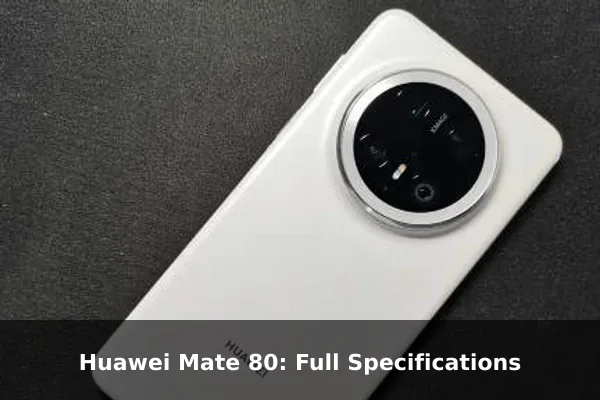
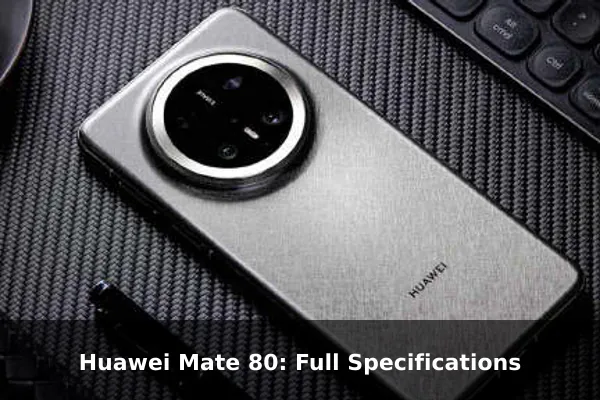
The Mate 80 measures 161.9 x 76 x 8 mm and weighs 217 g, placing it among the larger and slightly heavier flagships, though not unusually so for a 6.75-inch device. Huawei pairs a glass front with an aluminum alloy frame and a fiber-reinforced plastic back, a practical choice that keeps weight in check while resisting flex. The standout is durability: an IP68/IP69 rating means it is dust-tight and can handle high-pressure water jets as well as immersion up to 6 meters for 30 minutes, exceeding the more common IP68-only certification on rival phones. Four colors — Black, White, Green, and Gold — round out a restrained, professional look.
Display Experience
The 6.75-inch LTPO OLED panel is a highlight, running a 1280 x 2832 resolution for roughly 460 ppi and a crisp, high-density image. It supports a 120Hz adaptive refresh rate for smooth scrolling, 1440Hz PWM dimming to reduce eye strain at low brightness, and HDR Vivid for Huawei’s own high-dynamic-range content. With around an 89.7% screen-to-body ratio and Huawei Kunlun Glass 2 protection, the front is both immersive and resilient. For media, reading, and everyday use, this display comfortably matches what you would expect from far pricier flagships.
Performance and Software
Power comes from the 7 nm Kirin 9020, an octa-core chip clocked in a 1×2.5 GHz, 3×2.15 GHz, and 4×1.6 GHz arrangement, paired with the Maleoon 920 GPU. Memory options span 256GB/12GB, 512GB/12GB, and 512GB/16GB, though there is no microSD expansion, so buyers should pick storage carefully up front. The phone ships with HarmonyOS 6.0, Huawei’s own operating system. This is the most important consideration for international buyers: HarmonyOS does not include Google services, so app availability differs from standard Android. For users already invested in Huawei’s ecosystem, performance and integration are smooth; for others, it requires adjustment.
Camera System
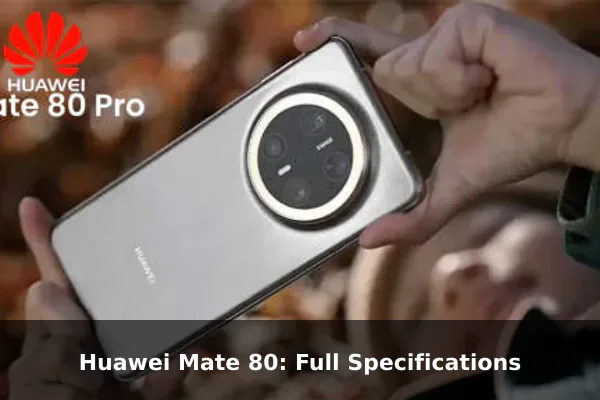
Imaging is where the Mate 80 punches above its price. The triple rear setup leads with a 50 MP wide sensor featuring a variable f/1.4-f/4.0 aperture and OIS, joined by a 12 MP periscope telephoto with 5.5x optical zoom and OIS, and a 40 MP 120-degree ultrawide. Huawei adds laser autofocus and a color spectrum sensor for more accurate white balance. Video tops out at 4K with OIS, gyro-EIS, and HDR Vivid, plus 1080p at 240fps for slow motion. On the front, a 13 MP ultrawide selfie camera includes AF and a TOF 3D sensor for depth and secure face biometrics. This is a genuinely versatile flagship-class camera array.
Battery and Charging
A large 5750 mAh battery should comfortably deliver a full day of heavy use, and the efficient 7 nm Kirin platform helps stretch it further. Charging is well-rounded: 66W wired for quick top-ups, 50W wireless for cable-free convenience, and both 5W reverse wired and reverse wireless output to power accessories or other devices. While rivals like some Xiaomi and Realme models push higher wired wattage, the Mate 80’s blend of a big cell plus fast wireless charging is one of the most complete packages in its price range.
Connectivity and Extras
Connectivity is comprehensive. The Mate 80 supports 5G (SA/NSA), Wi-Fi 7, Bluetooth 6.0 with Huawei’s L2HC codec, NFC, an infrared port, and USB Type-C 3.1 with DisplayPort 1.2 for external displays. Positioning is exhaustive, covering multi-band GPS, BeiDou, Galileo, GLONASS, QZSS, and NavIC. A side-mounted fingerprint sensor and face unlock handle security. One region-specific extra is BeiDou satellite calling and messaging, though this is noted as available in China only, so overseas buyers should not count on it.
Who Should Buy the Mate 80?
The Mate 80 is best suited to buyers inside or comfortable joining Huawei’s ecosystem who want flagship cameras, strong battery life, and top-tier durability without paying Pro-tier prices. Photographers, frequent travelers who value rugged water resistance, and existing Huawei users are the natural audience. Anyone who depends on Google apps or wants the widest app-store compatibility should weigh that limitation seriously before choosing it over a Samsung or Google alternative.
Conclusion
The Huawei Mate 80 delivers an impressive amount of flagship hardware — a variable-aperture 50 MP camera, 5.5x periscope zoom, a sharp 120Hz LTPO OLED, IP68/IP69 durability, and versatile fast charging — for around 570 EUR. Its main trade-off is HarmonyOS 6.0 without Google services, which defines its ideal buyer. If you are happy within Huawei’s software world, the Mate 80 is an outstanding value; if you need Google apps, look elsewhere. Prices, availability, and regional features can change, so confirm current details with Huawei before purchasing. Recommended for Huawei ecosystem users and imaging-focused buyers seeking flagship features on a mid-flagship budget.
References
- Huawei Consumer – HUAWEI Mate 80 specifications – Primary source for the Mate 80's official dimensions, display, processor, memory, cameras, battery, charging, connectivity, OS, and durability claims.
- Huawei Consumer – HUAWEI Mate 80 product page – Official product page for headline features, launch positioning, colors, official starting price, and feature footnotes.
- Huawei Mall – HUAWEI Mate 80 listing – Official Huawei retail listing useful for current China-market pricing, SKU options, availability, model identifiers, and purchase configuration details.
- Huawei Consumer – HUAWEI Mate 80 Pro specifications – Primary source for confirming Mate 80 Pro variant differences if the article discusses the wider Mate 80 family.
- The Verge – Huawei Mate 80 Pro Max coverage – Reputable independent technology publication for cross-checking launch status, regional availability context, and notable display and family-level announcements.
