
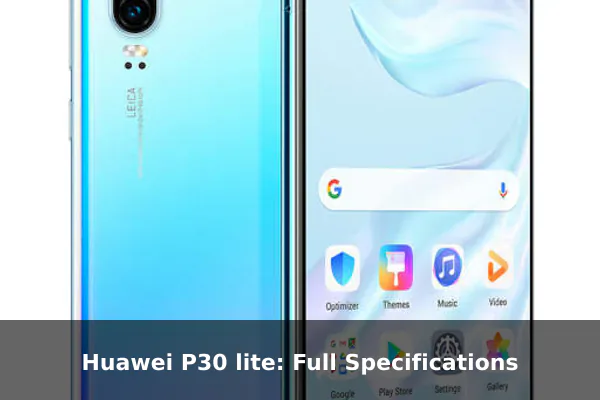
Huawei P30 lite is a 2019 Huawei mid-range smartphone built around a slim glass design, a 6.15-inch Full HD+ IPS LCD, the Kirin 710 chipset, and triple rear cameras. It sits below the flagship P30 models, but it keeps practical features such as expandable storage, USB-C, a 3.5mm headphone jack, and a rear fingerprint sensor.
This specs-focused overview highlights how the P30 lite holds up today as a discontinued LTE phone, with attention to regional network variants, camera options, battery endurance, software limits, and buyer fit. A separate full specifications table can be used for exact band, memory, model, and test data.
Full Specifications
Network
| Technology: | GSM / HSPA / LTE |
| 2G bands: | GSM 850 / 900 / 1800 / 1900 |
| 3G bands: | HSDPA 850 / 900 / 1700(AWS) / 1900 / 2100 – Europe, Canada |
| HSDPA 850 / 900 / 1900 / 2100 – Asia | |
| 4G bands: | 1, 3, 4, 7, 8, 20, 38 – Europe |
| 1, 3, 5, 7, 8, 28, 34, 38, 39, 40, 41 – Asia | |
| 1, 2, 3, 4, 5, 7, 8, 12, 17, 28, 66 – Canada | |
| Speed: | HSPA 42.2/5.76 Mbps, LTE (2CA) Cat6 400/50 Mbps |
Launch
| Announced: | 2019, March 27. Released 2019, April 25 |
| Status: | Discontinued |
Body
| Dimensions: | 152.9 x 72.7 x 7.4 mm (6.02 x 2.86 x 0.29 in) |
| Weight: | 159 g (5.61 oz) |
| Build: | Glass front, glass back, plastic frame |
| SIM: | Nano-SIMNano-SIM + Nano-SIM |
Display
| Type: | IPS LCD |
| Size: | 6.15 inches, 93.6 cm2 (~84.2% screen-to-body ratio) |
| Resolution: | 1080 x 2312 pixels, 19.3:9 ratio (~415 ppi density) |
Platform
| OS: | Android 9.0 (Pie), upgradable to Android 10, EMUI 10.0 |
| Chipset: | Kirin 710 (12 nm) |
| CPU: | Octa-core (4×2.2 GHz Cortex-A73 & 4×1.7 GHz Cortex-A53) |
| GPU: | Mali-G51 MP4 |
Memory
| Card slot: | microSDXC (uses shared SIM slot) |
| Internal: | 64GB 4GB RAM, 128GB 4GB RAM, 128GB 6GB RAM, 128GB 8GB RAM, 256GB 4GB RAM, 256GB 6GB RAM |
| eMMC 5.1 |
Main Camera
| Triple: | 48 MP, f/1.8, 27mm (wide), 1/2.0″, 0.8µm, PDAF 8 MP, 17mm (ultrawide) 2 MP, f/2.4, (depth) or 24 MP, f/1.8, (wide), PDAF 8 MP, 17mm (ultrawide) 2 MP, f/2.4, (depth) |
| Features: | LED flash, HDR, panorama |
| Video: | 1080p@30fps (gyro-EIS) |
Selfie camera
| Single: | 24 MP, f/2.0, 26mm (wide), 1/2.8″, 0.9µm or 32 MP, f/2.0, 26mm (wide), 1/2.8″, 0.8µm |
| Features: | Panorama |
| Video: | 1080p@30fps |
Sound
| Loudspeaker: | Yes |
| 3.5mm jack: | Yes |
Comms
| WLAN: | Wi-Fi 802.11 a/b/g/n/ac, dual-band, Wi-Fi Direct |
| Bluetooth: | 4.2, A2DP, LE, aptX HD |
| Positioning: | GPS, GLONASS, BDS |
| NFC: | Yes – MAR-L21MEA, MAR-LX1M only |
| Radio: | FM radio (market dependent) |
| USB: | USB Type-C 2.0, OTG |
Features
| Sensors: | Fingerprint (rear-mounted), accelerometer, gyro, proximity, compass |
Battery
| Type: | Li-Po 3340 mAh, non-removable |
| Charging: | 18W wired |
Misc
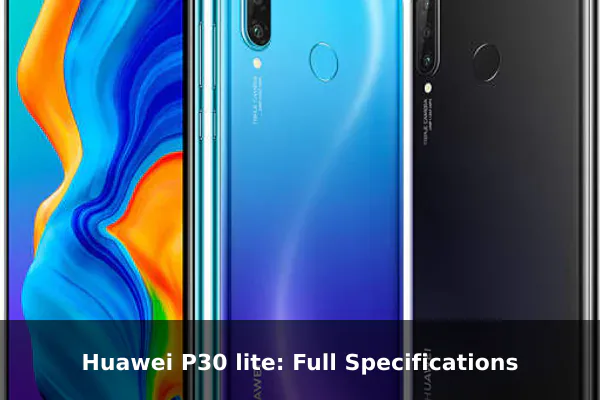
| Colors: | Peacock Blue, Midnight Black, Pearl White |
| Models: | MAR-LX1M, MAR-AL00, MAR-TL00, MAR-LX2, Marie-L21A, Marie-L01A, Marie-L21MEA, Marie-L22A, MAR-LX1A, MAR-LX3A, MAR-LX2J, MAR-LX1B, MAR-LX3Bm, MAR-LX3Am |
| Price: | About 420 EUR |
Our Tests
| Performance: | AnTuTu: 141600 (v7) GeekBench: 5549 (v4.4) GFXBench: 6.9fps (ES 3.1 onscreen) |
| Display: | 1231:1 contrast ratio, 501 nits max brightness (measured) |
| Camera: | Photo / Video |
| Loudspeaker: | Voice 71dB / Noise 73dB / Ring 83dB |
| Audio quality: | Noise -94.4dB / Crosstalk -71.2dB |
| Battery (old): | Endurance rating 94h |
Price and Availability
The Huawei P30 lite offers a compelling combination of features and performance. While the base price is around €420, the actual cost may vary depending on your location and retailer. Below, you’ll find the approximate price of the Huawei P30 lite converted into various currencies. Please note that these are estimates based on recent exchange rates as of August 16, 2026 and may not reflect the exact price you’ll find at a retailer.
- United States: $486
- Japan: ¥77,340
- United Kingdom: £359
- Australia: A$686
- Canada: C$674
- Taiwan: NT$15,545
- Denmark: kr3.140
- Saudi Arabia: ﷼1,821
- South Korea: ₩686,972
- Germany: €420
- Brazil: R$2.520
- Vietnam: ₫12.667.463
- Kenya: KSh 62,765
- India: ₹46,351
- Indonesia: Rp 8.649.779
- Nigeria: ₦660,327
- Pakistan: ₨134,823
- Philippines: ₱29,832
- Bangladesh: ৳৫৯,৬৫৩
Value Position
The Huawei P30 lite launched as a polished upper-entry to mid-range Android phone rather than a budget basics model. Its original price positioning of about 420 EUR placed it in a competitive space where design, camera flexibility, and storage mattered as much as raw speed. Today, its value depends heavily on condition, battery health, software expectations, and whether the regional model supports the LTE bands needed by the buyer.
The main appeal is that the phone still offers a balanced set of everyday features: a sharp Full HD+ display, lightweight body, microSD expansion, USB-C, headphone jack, NFC on selected models, and a capable 3340 mAh battery. The main limitation is age. Buyers should treat it as a used or refurbished LTE phone, not as a modern long-term upgrade.
Design and Handling
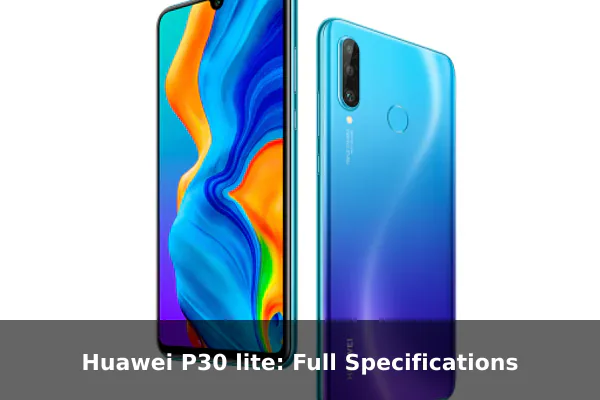
At 152.9 x 72.7 x 7.4 mm and 159 g, the Huawei P30 lite is noticeably lighter and slimmer than many newer large-screen phones. The glass front and glass back give it a more premium feel than many plastic-heavy mid-range devices, while the plastic frame helps keep weight down. The Peacock Blue, Midnight Black, and Pearl White finishes also make it visually distinct from more conservative business-style phones.
The rear-mounted fingerprint reader is practical and quick for one-handed unlocking, especially for users who prefer a physical sensor over in-display readers. The hybrid SIM arrangement is worth noting because microSD expansion uses the shared SIM slot, so buyers may need to choose between a second Nano-SIM and extra storage.
Display Experience
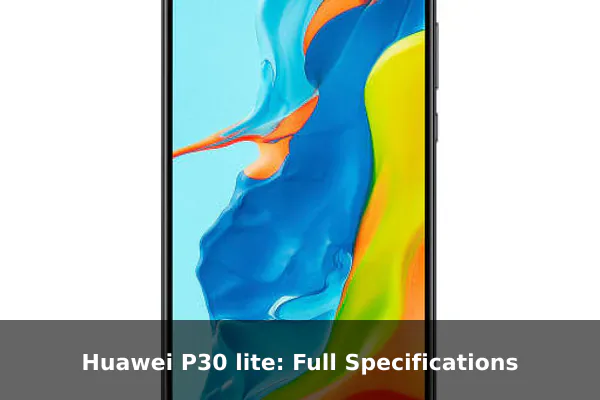
The 6.15-inch IPS LCD is one of the P30 lite’s stronger everyday features. Its 1080 x 2312 resolution produces a sharp pixel density of around 415 ppi, which is still crisp for browsing, messaging, documents, and video. The measured 501 nits maximum brightness and 1231:1 contrast ratio are respectable for an LCD panel from this class and period.
Because it uses IPS LCD rather than OLED, users should not expect deep OLED blacks, always-on display behavior, or the contrast punch of newer premium panels. The tradeoff is a natural-looking screen that remains useful for general tasks, especially for buyers who prioritize sharpness over high refresh rates or HDR features.
Performance and Storage
The Kirin 710 chipset pairs four Cortex-A73 performance cores with four Cortex-A53 efficiency cores, backed by Mali-G51 MP4 graphics. In daily use, this platform is best suited to messaging, web browsing, streaming, navigation, banking apps, and light multitasking. The listed benchmark results, including AnTuTu v7 at 141600 and GeekBench v4.4 at 5549, reflect a mid-range phone of its generation rather than a gaming-first device.
Storage options are broad, ranging from 64GB with 4GB RAM up to 256GB configurations with 4GB or 6GB RAM, depending on market. The use of eMMC 5.1 storage means app loading and large file transfers will not feel as fast as modern UFS-based phones, but the microSDXC slot is a practical advantage for media libraries and offline files.
Camera Setup
The Huawei P30 lite was sold with different rear camera configurations depending on region, including a 48 MP wide camera or a 24 MP wide camera, paired with an 8 MP ultrawide camera and a 2 MP depth sensor. This gives the phone more flexibility than a single-camera device, especially for landscapes, travel scenes, group photos, and portrait-style depth effects.
Video recording tops out at 1080p at 30fps with gyro-EIS, so the P30 lite is not aimed at users who need 4K recording or advanced creator features. The selfie camera also varies by market, with 24 MP or 32 MP options. For social photos, video calls, and casual clips, it remains serviceable, but low-light results and motion handling should be judged with realistic expectations for a 2019 mid-range sensor package.
Battery and Charging
The 3340 mAh non-removable battery is modest by current capacity standards, but the P30 lite’s efficient chipset, LCD panel, and LTE-only design helped it achieve a reported 94-hour endurance rating in older battery testing. Actual performance in 2026 depends strongly on battery wear, so used units may need a replacement battery to feel close to original endurance.
Charging is handled by 18W wired charging over USB Type-C. That is not fast by current standards, but it is still more convenient than older microUSB budget phones and adequate for overnight charging or shorter top-ups during the day.
Software and App Support
The phone launched with Android 9.0 Pie and is listed as upgradable to Android 10 with EMUI 10.0. That software ceiling is important for buyers who depend on newer Android platform features, long security support, or apps that may eventually drop older OS versions. It can still work well for basic phone duties, but it should not be chosen by anyone who wants years of fresh Android updates.
Huawei’s EMUI interface offers many customization options, battery controls, and system tools. However, software experience can vary by region and firmware history, so a used device should be checked for reset status, update availability, app compatibility, and account lock status before purchase.
Connectivity and Regional Variants
The Huawei P30 lite supports GSM, HSPA, and LTE, with Cat6 LTE rated at up to 400 Mbps downlink and 50 Mbps uplink under ideal network conditions. There is no 5G support, which is expected for its launch period. The important detail is that LTE band support differs across Europe, Asia, and Canada variants, so model number matters more than the name alone.
Connectivity is otherwise well rounded. The phone includes Wi-Fi 802.11 a/b/g/n/ac dual-band, Bluetooth 4.2 with aptX HD, GPS, GLONASS, and BDS positioning, FM radio depending on market, USB OTG, and a 3.5mm audio jack. NFC is available only on selected models such as MAR-L21MEA and MAR-LX1M, so mobile payment users should verify the exact variant before buying.
Who Should Buy It?
The Huawei P30 lite makes the most sense for buyers who want a slim, lightweight LTE Android phone for calls, messaging, media, photography basics, and expandable storage. It is also a reasonable choice for collectors of Huawei’s pre-5G mid-range lineup or users who specifically want a headphone jack and rear fingerprint reader in a compact-feeling body.
It is less suitable for buyers who need 5G, current Android versions, heavy gaming performance, 4K video, guaranteed long-term security updates, or the strongest low-light camera quality. For those users, a newer mid-range Android phone will be the better comparison point.
Conclusion
The Huawei P30 lite remains a well-rounded older LTE smartphone with a sharp display, light design, useful triple-camera flexibility, expandable storage, and strong practical features for its era. Its age, discontinued status, Android 10 software limit, and regional NFC or LTE differences are the main cautions. Buy it only if the price is low, the battery is healthy, and the exact model matches your network needs.
References
- HUAWEI Consumer – HUAWEI P30 lite Specification – Official manufacturer specifications for the HUAWEI P30 lite CEE/WEU model, covering dimensions, display, connectivity, sensors, battery, ports, and in-box items.
- HUAWEI Consumer – HUAWEI P30 Lite 256GB Specifications – Official Huawei specification page for the 256GB/New Edition variant, useful for verifying variant-specific RAM, storage, camera, NFC, and network details.
- HUAWEI Support Japan – HUAWEI P30 lite Support – Official Huawei support page for the P30 lite with manuals and model support information, useful for checking product documentation and release details.
- GSMArena – Huawei P30 lite – Well-known phone specification database useful for cross-checking launch date, model variants, chipset, camera, battery, network bands, and memory configurations.
- PhoneArena – Huawei P30 Lite Full Specifications – Established smartphone reference site with a structured full-specifications page for independent comparison against Huawei's official data.
